Clan invasion: How new mechs and elementals are changing the gameplay in BattleTech
With the arrival of the Clans, the BattleTech universe has undergone massive changes— not only in terms of Lore, but also at the gaming table, where the invasion of the Clans’ genetically enhanced warriors has turned everything upside down. The BattleMechs of the Succession Wars suddenly find themselves up against technology that makes them look outdated in many areas. In this article, we’ll take a look at what sets the new Clan BattleMechs and Elementals apart and how they’re permanently changing the gameplay—particularly through their superior weapon range and firepower.
The return of lost technology
During the centuries of the Succession Wars, technology was a precious commodity in the Inner Sphere. Many weapon systems, production methods, and specifications were lost. BattleMechs were cumbersome, their weapons limited in range and effectiveness, and repairs were often improvised.
With the return of the Clans in the year 3050, this technological stagnation came to an abrupt end. While in isolation, the Clans had not only preserved the old technology but had even further developed it. As a result, in direct comparison, their BattleMechs seem to be from a different era.
Range—the First Shock on the Battlefield
One of the most striking features of Clan technology is the increased weapon range. Whereas an IS (Inner Sphere) Mech attempts to land its first hits at medium range, Clan Mechs often open fire from a safe distance.
Examples:
- Clan laser weapons (e.g., ER Medium Laser or ER Large Laser) consistently offer greater range while maintaining the same or even greater firepower.
- ClanGauss cannons or ER-PPCs hit their targets with precision at ranges where IS mechs are often still moving to get into position.
- Even missile weapons like the Clan LRM-20 benefit from a more compact design and greater efficiency.
On the gaming table, this means that clan players can open fire earlier, weakening their opponents on the way into battle while remaining outside the optimal range of IS weapons. Those playing against clans must learn to take damage before they even get into effective range.
In BattleTech Alpha Strike, this increased range of Clan weapons—due to the defined ranges (Short, Medium, and Long)—is usually expressed in one way: higher damage values at long and medium ranges. The range definitions are independent of this. In BattleTech Classic, however, the difference is even more significant.
Impact – less is more
The next major strength is the power of the clan weapons. Compared to Inner Sphere weapons, Clan weapons are not only lighter and more compact, but also deal more damage. Even light and medium-weight Clan BattleMechs can deal enormous damage.
The difference in striking power with comparable tonnage is shown here using an example between a Clan and an Inner Sphere BattleMech in the middle category. The comparison between the Shadow Hawk SHD-3H (Inner Sphere technology) and the Shadow Hawk IIC (Clan):

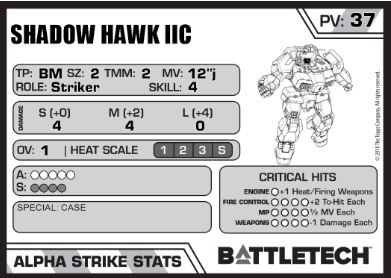
The Shadow Hawk SHD-3H weighs 55 metric tons, while the Shadow Hawk IIC weighs only 45. Despite its lower weight (45 metric tons vs. 55 metric tons), the Clan Mech has twice the firepower at medium and short ranges. And it does so while boasting higher movement stats. So it’s not only more heavily armed but also more agile—two deadly advantages in combat.
The consequence: Clan mechs need fewer weapons to deal the same or more damage, which in turn leaves more room for jump jets, heat sinks, additional weapons or armor. Efficiency is key – Clan designs are usually “min-maxed”, while IS mechs often have to make compromises.
The surprise on the floor: Elementary
It’s not just the Clans’ mechs that bring a breath of fresh air—the Elementals, the powerful Battle Armor suits for infantry, also present a new tactical challenge.
- Tough: Elementals are hard to take down and can withstand hits that would instantly destroy normal infantry.
- Mobility: They can latch onto mechs and deal damage at close range—a brand-new tactical element.
- Versatility: Equipped with jump jets, SRMs, and machine guns, they can be deployed against vehicles, mechs, and infantry.
For players in the Inner Sphere, this means: new threats on the battlefield that cannot be ignored without paying the price later.
Conclusion: The Clans are redefining the game
With their superior weapons, range advantages, and resilient support units, the Clans are noticeably shifting the game’s balance. Anyone who stands against them must develop new tactics, make better use of the terrain, and work more closely together to hold their own against this technological superiority.
For the game, this means:
- More Dynamism in Combat
- Fierce firefights at longer ranges
- Greater tactical challenges thanks to new unit types such as Elementals
What at first glance looks like a massive advantage for the clans actually opens up exciting new challenges for both sides – and provides fresh impetus on the BattleTech Alpha Strike gaming table.
Popular Scenario: Inner Sphere vs. the Clans at the Start of the Clan Invasion
A particularly popular and thematically compelling game setup is the battle between the Inner Sphere and the Clans at the start of the invasion in the year 3050. This phase of the conflict is marked by unequal odds, surprising encounters—and dramatic twists.
The Inner Sphere: Outdated Technology, Courage, and Improvisation
At the beginning of the invasion, the Inner Sphere fought almost exclusively with “old-school” BattleMechs, i.e. machines with technologies developed centuries ago. These mechs are often more cumbersome, less well cooled and carry less effective weapons. They are based on proven designs such as the WarhammerShadow Hawk or Awesome, which are robust but clearly inferior in terms of technology.
It was only over time – especially after the first battles with Clan units – that the Houses of the Inner Sphere began to upgrade their mechs with so-called “LosTech” elements. The first wave of modernized mechs (often known as “3050 variants”) used captured or reconstructed technologies:
- Dual Cooling Systems
- Advanced targeting systems
- Improved Reactors
- Initial trials with advanced clan-based weapons (e.g., ER lasers, improved rocket launchers)
Nevertheless, a noticeable gap remained—both technically and tactically. The Inner Sphere’s doctrine was geared toward mass production, positional warfare, and lines of fire—in contrast to the Clans’ fast, mobile style of warfare.
The Clans: Blitzkrieg in Its Purest Form
The Clans, on the other hand, operated with perfectly coordinated “Stars” (groups of five Mechs), engaged in battles of honor, and relied on rapid advances, precise fire, and superior technology. The Clans did not expect coordinated resistance—and were correspondingly successful in the early stages.
For tabletop gamers, this results in an exciting asymmetrical conflict:
- The Inner Sphere often has numerical superiority, but must rely on coordination, cover, and clever maneuvers.
- The Clans have fewer units but are superior in firepower, range, and mobility—though they must use their limited number of elite Mechs and pilots carefully.
This setting is what makes it so appealing: David against Goliath, with the open question of whether tactics, courage and terrain can compensate for technological superiority.

Ich bin Sören Spieckermann, der Kopf hinter mechstrategen. Seit Jahren faszinieren mich taktische Tabletop-Schlachten und die strategische Tiefe von Mechs. Ob schnelle Gefechte in Halo: Flashpoint oder epische Schlachten bei BattleTech Alpha Strike – hier teile ich meine Erfahrungen und Taktiken mit dir. Mein Ziel? Sowohl Einsteigern den Start zu erleichtern als auch alten Hasen neue Impulse für das nächste Match zu geben.