The Symmetry Dilemma: Why I Prefer Unbalanced Scenarios to Perfectly Balanced Matches
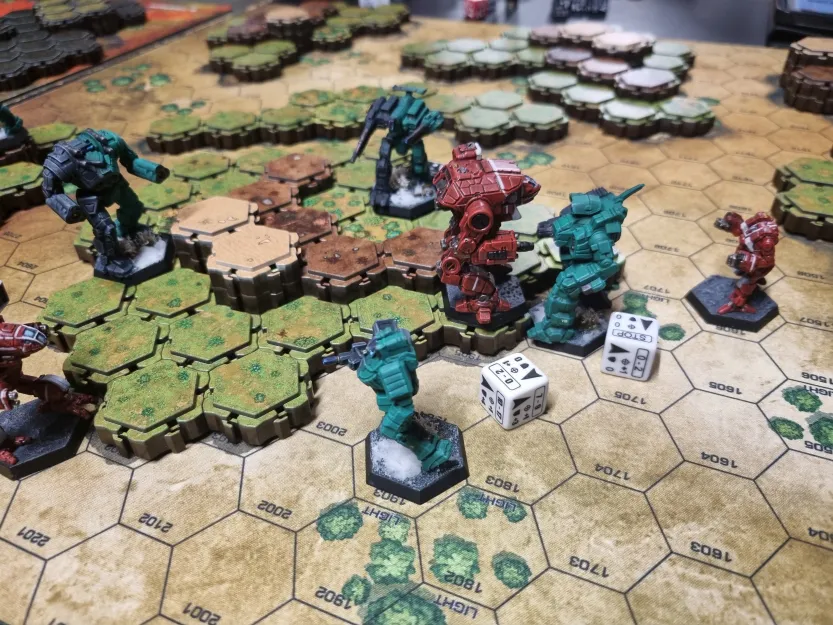
You know how it is: You’re sitting at the game table, both sides have set up their point values to the exact same decimal place, the terrain pieces are laid out precisely—and usually mirror-inverted—across the mat, and in front of you lies a completely neutral stand-up fight scenario. Whoever has the last ‘Mech standing at the end wins.
That’s nice, it’s fair, and it’s absolutely necessary at tournaments. But let’s be honest: In the long run, that can get pretty boring, right?
In my hobby, I keep finding myself skipping over exactly these smooth, perfectly balanced matches and instead throwing myself with full enthusiasm into unbalanced, asymmetrical scenarios. But why, exactly? Why is a game of BattleTech Alpha Strike so much more fun when the conditions aren’t exactly the same?
The illusion of “perfect balance” on the game table
On paper, the mathematical comparison sounds appealing: If my lance has exactly 350 Point Value (PV) and your clan star is also at 350 PV, we have a fair match. But as soon as the first roll is made or the terrain comes into play, this theoretical balance dissolves anyway.
A tournament match often requires perfectly symmetrical conditions to determine which player or list is better. But in the reality of the Inner Sphere—and that’s exactly where my tabletop heart lies—no battle is ever symmetrical. Who goes into battle expecting the enemy to bring exactly the same firepower?
The Appeal of Asymmetry:
Symmetrical games often just test who has the most optimized point-value build or who is better at reading the dice statistics. Asymmetrical games, on the other hand, test your ability to make decisions under real pressure and make the best of a terrible situation.
Storytelling Through Imbalance: The Real “Fog of War”
The main reason I love asymmetrical scenarios is the sense of narrative and drama they provide.
When I play a scenario in which one side is clearly superior in terms of numbers or point values, a story immediately unfolds:
- The Desperate Battle: A damaged rearguard attempts to delay the advance of a numerically superior enemy long enough for the landing ships to evacuate (Hold the Line).
- The Unequal Chase: Fast but lightly armored units must rescue valuable cargo across the enemy’s deployment zone while heavy equipment is hot on their heels.
- Hidden Learning Curve: An attacker must conduct reconnaissance and scan for targets while the defender operates from ambush.
In games like these, the goal isn’t simply to wipe the opponent off the table. The defender or the outnumbered side does not win by destroying everything, but by achieving its strategic objective or making it as costly as possible for the opponent to achieve theirs. This creates a sense of playful tension that a mere back-and-forth exchange simply cannot provide.
Unbalanced does not mean unfair!
One must not confuse “unbalanced” with “unplayable” or “unfair.” A good asymmetrical scenario deliberately uses imbalances as a game mechanic:
- Different Victory Conditions: If one side scores twice as many points, the other side might only have to survive 4 rounds or hold a single building.
- Dynamic Reinforcements: The enemy starts with a massive numerical advantage on the battlefield, but my reinforcements arrive in dribs and drabs—which can turn the tide as the game progresses.
- Terrain and Hiding Places: Numerical inferiority is often offset by terrain advantages, prepared positions, or hidden units.
Anyone who agrees to such conditions is forced to think in a completely different way. Tactics like Forced Withdrawal (the orderly retreat of battered units) suddenly make perfect sense and are no longer just a nuisance. I fight for every inch of ground and every MechWarrior because the resources on the table matter.
Practical example: The evacuation scenario “Evacuation of Depot Gamma”
To show just how awesome an extremely asymmetrical setup at the gaming table feels, I’ve put together a specific scenario for you here. In this scenario, 150 PV of desperate mercenaries face off against 300 PV of concentrated elite firepower from the Capellan Confederation!
Background: Specific Case
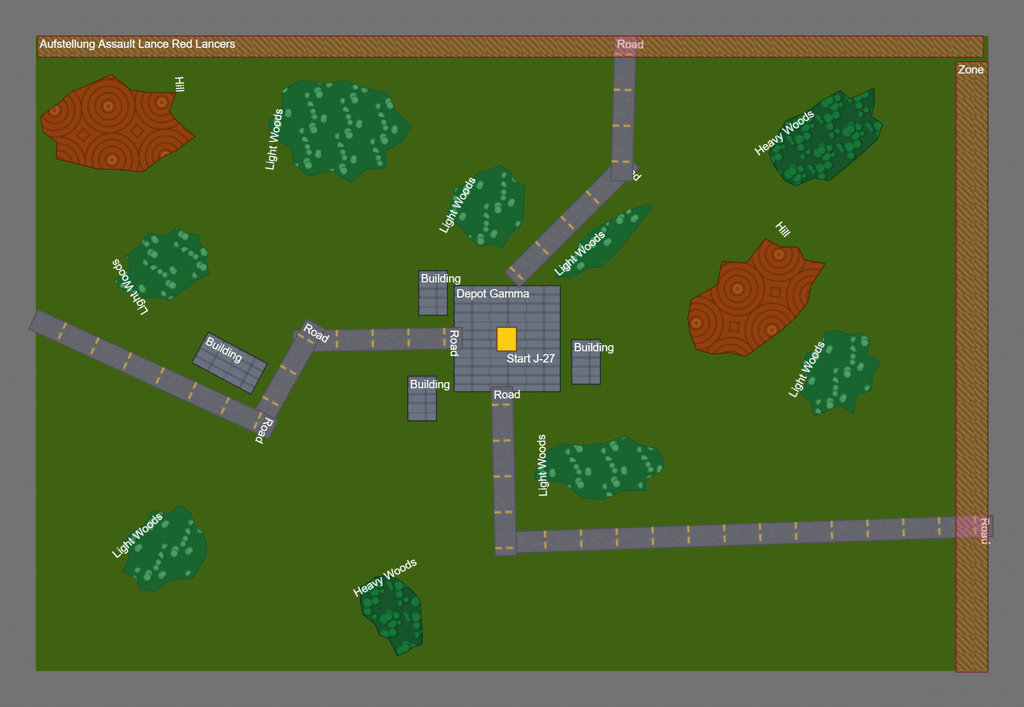
The Canopian Highlanders (mercenaries) are holding an isolated supply depot in the center of the battlefield. Three nearly unarmed J-27 Ordnance Transport units are loading the last of the critical supplies. The opposing Red Lancers are advancing with an overwhelming force from two directions simultaneously to completely overrun the depot.
Setup & Installation
- Playing field: Standard 4′ x 4′ or 4′ x 6′ (or matching hex-grid mats). The depot is located exactly in the center of the playing field. It is surrounded by a few buildings and patches of forest. Several roads lead out of the depot.
- Canopian Highlanders (Defender – 150 HP):
- Deploy your forces within 6 inches of the depot.
- Transporters: 3 unarmed J-27 Ordnance Transport units start right in the center of the depot. They move westward using their normal movement range during the defenders’Movement Phase.
- Red Lancer (Attacker – 300 HP):
- Northern Deployment Zone: A spearhead consisting of exactly 4 heavy/assault combat units (Size 3 or 4) enters the battlefield via the northern edge.
- Eastern Deployment Zone: The entire remainder of the Red Lancer force enters the battlefield via the eastern edge.
- Game duration: Up to 8 rounds.
Mission Objectives
Defenders: Canopian Highlanders (Mercenaries)
- Primary Objective (+4 Victory Points): Successfully escort at least 2 of the 3 J-27 Ordnance Transport units off the board via the western edge of the playing field.
- Secondary Objective (+2 Victory Points): Prevent Red Lancer units from occupying the Depot (center) by the end of Round 3. The Depot is considered occupied by the side that has more units (total of their Size values) within the Depot’s boundaries.
Attacker: Red Lancer
- Primary Objective (+4 Victory Points): Destroy at least 2 of the 3 J-27 Ordnance Transport units before they reach the western edge of the playing field.
- Secondary Objective (+2 Victory Points): Destroy or force the withdrawal of at least 70% (105 HP) of the defending mercenary units (based on the total HP value).
Tactical Tip for Defenders: As a Canopian Highlander, you simply don’t stand a chance in a classic attrition battle against 350 HP. Your units must act as a shield, blocklines of sight, secure critical chokepoints, and intercept jump movements. Pay special attention to the four heavy units coming from the north—they’ll cut off your J-27 transporters’ route to the western edge! Every turn the Red Lancers spend fighting your mechs instead of firing at the freighters brings you closer to victory.
My Conclusion
Symmetrical, perfectly balanced matches definitely have their place—especially if you want to play a quick, fair round at a tournament. But to be honest, the games that really stick in my memory are the ones where things really went off the rails.
The games where I had to fight against overwhelming odds for every mission objective, where a single remaining Medium ‘Mech held the line, or where retreat was the only sensible decision— those are the stories that keep me doing this hobby. Don’t be afraid to tackle uneven matchups more often, take full advantage of the scenario rules, and let yourself be surprised by the amazing moments that arise at the gaming table!
Transparency notice on the use of AI (in accordance with the EU AI Act):
The content of this blog is personally conceived, researched and defined by me. I use generative artificial intelligence to help me formulate and structure the texts.
Why? This enables me to prepare complex issues more precisely and to focus fully on the quality of the content and research. The final editorial control and responsibility for all published content lies solely with me.
Together for better content!
This blog is a project of the heart that can only continue to grow with your help. Every comment, every recommendation – and especially your financial support – secures the future of this platform.
Do you want this content to remain freely accessible?
This is how you can support the mission:
- NEWSLETTER REGISTRATION: Become part of the fast-growing community and never miss an update again!
- BECOME A PATREON MEMBER: Join the inner circle and get access to exclusive material and early releases.
- OTHER SUPPORT: Whether it’s a donation, sharing a post or recommending the blog to others – every form of support counts!
Let’s make this blog an even better place together!

Ich bin Sören Spieckermann, der Kopf hinter mechstrategen. Seit Jahren faszinieren mich taktische Tabletop-Schlachten und die strategische Tiefe von Mechs. Ob schnelle Gefechte in Halo: Flashpoint oder epische Schlachten bei BattleTech Alpha Strike – hier teile ich meine Erfahrungen und Taktiken mit dir. Mein Ziel? Sowohl Einsteigern den Start zu erleichtern als auch alten Hasen neue Impulse für das nächste Match zu geben.