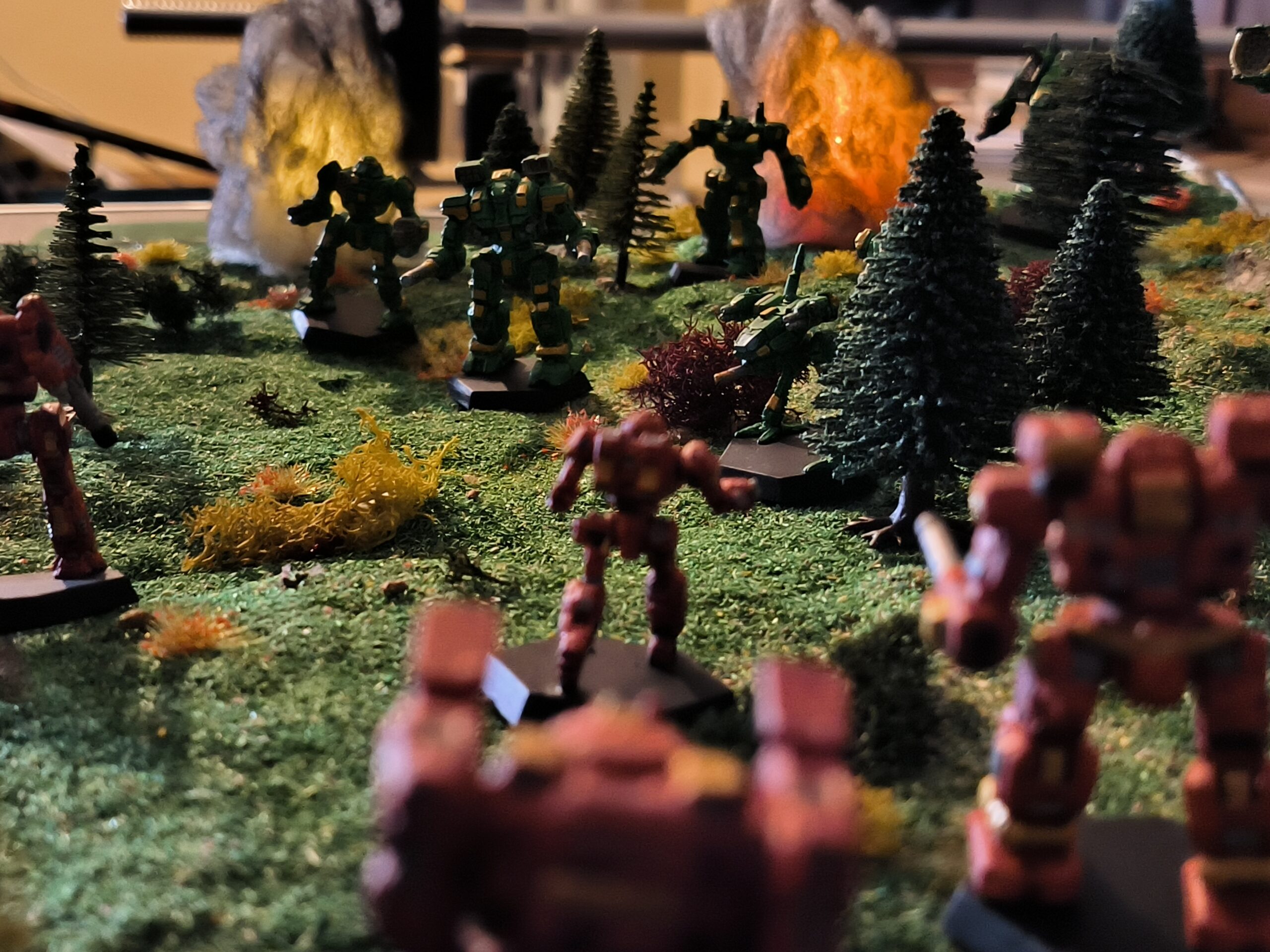
AI as troop master: How to build the perfect Alpha Strike list with Gemini & Co.
AI in the tabletop hobby? I know that many of you will roll your eyes at this topic at first. And to be honest, I completely understand this skepticism. Our hobby thrives on creativity, haptics, passion and real manual work – a digital algorithm quickly seems like a foreign body that threatens the soul of the game.
But let me briefly clarify how I see the whole thing: For me, an AI is not a replacement for the hobby experience, but a damn useful assistant for the logistics in the background. I really enjoy using AI support to speed up slow processes. But the reins remain firmly in my hands. The AI only delivers raw data volumes – the direction, structure and final decisions come entirely from me.
In the end, every result is meticulously checked, sifted out and personally formulated by me. Absolutely nothing goes online unchecked and unedited – neither here on the blog nor on my gaming table!
If you know how to use the AI correctly, you can save a lot of time when building forces for BattleTech Alpha Strike. Let’s take a look at how this works in practice for larger formations.
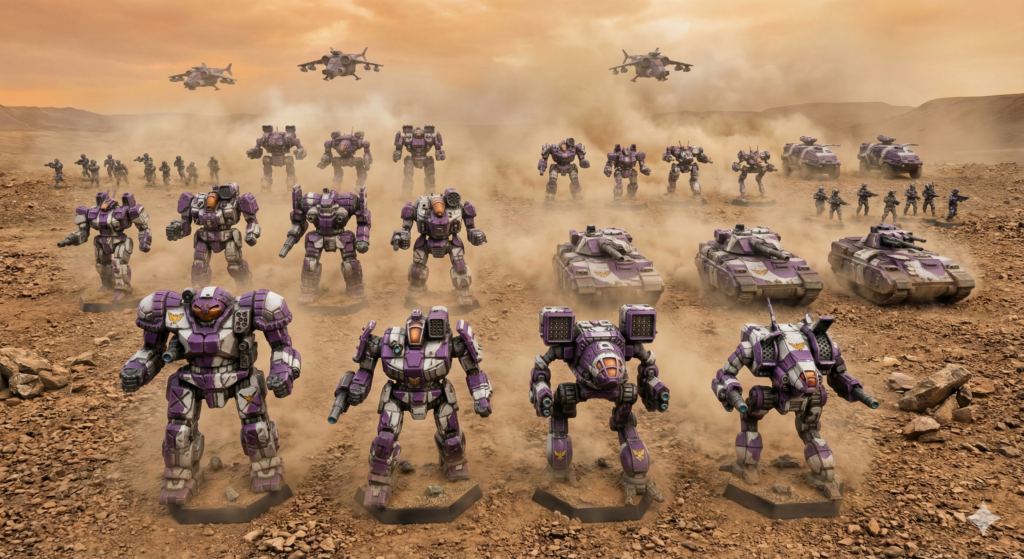
Why AI support for force building at all?
The short answer: Variability at the touch of a button and enormous time savings. An AI has no preferences for certain mechs. It doesn’t suffer from “decision paralysis” (inability to make decisions when faced with too many choices) and it throws together combinations in seconds that I might never have thought of myself. Regardless of whether I’m looking for a tough tournament list or a thematically dense, narrative squad – the AI provides me with a fantastic basic framework.
But be careful: an AI doesn’t inherently know what you have in your cupboard. If you just type: “Build me a Lyran Commonwealth company”, you’ll often end up with chaos. That’s why I use a clear, three-stage workflow.
The 3-step workflow for the AI list
We take a strategic approach to ensure that the result is really playable and fits in with your collection.
Step 1: The inventory including PV values
Before we feed the AI, we need to tell it what resources are available. Create a simple list of your mechs, tanks, VTOLs and infantry units.
- Name the variant: Add the exact name of the variant you want to play. Otherwise, AIs tend to suddenly equip mechs with clan tech in the Succession War scenario.
- Include PV values: Be sure to add the respective PV value (point value) of the unit. Since AIs are language models and not math geniuses, you make it much easier for them to calculate if the values are already there.
Example for your inventory list: - 1x Atlas AS7-D (PV: 52)
- 1x Warhammer WHM-6R (PV: 32)
- 1x Phoenix Hawk PXH-1K (PV: 23)
- 1x Locust LCT-1V (PV: 14)
- 4x Vedette Medium Tank (Standard) (PV: 14)
Step 2: Feed the AI
Copy this list including the PV values, open the AI of your choice (e.g. Gemini) and prepare it to act as your tactical advisor.
Excursus: The anatomy of the perfect prompt
Before we send the command, let’s take a look at how an optimal prompt should be structured. If you only throw chunks at the AI, you will only get digital rejects back. A watertight forcebuilding prompt is always based on five fixed pillars:
- 1. the role (persona): Tell the AI exactly who it has to be. If it is supposed to behave as an “experienced BattleTech strategist”, it will use completely different language patterns and logic than when writing general texts.
- 2. the context (the setting): This is where you set the scene. Which faction are we playing? What era are we playing in? Without this information, the AI will wildly throw together units that have never historically fought together in the BattleTech universe.
- 3. the hard limits (the rules): This is where the mathematical corset is tightened. What is the maximum PV limit? What skill level do we take as a basis?
- 4. the target structure (the layout): Tell the AI exactly how you want the end result to be structured. Do you want a loose list? Or – much better – should it divide the units directly into fixed lances according to the rules of the Commander’s Edition (e.g. Battle Lance, Recon Lance)?
- 5. the guard rails (do’s & don’ts): The most important protective shield against AI errors. Explicitly order it to only use the units you provide and not to invent any variants.
If you observe these five pillars, the AI will mutate from an error-prone chatbot into a precise logistics officer.
Step 3: The precise prompt
Now we are putting theory into practice. We’re going to really challenge the AI and let it structure a complete company plus vehicle support according to exactly this five-pillar principle.
Here is the concrete prompt example for a company that you can copy for yourself:
📋 Prompt template for Gemini (Kompnie)
“You are an experienced BattleTech Alpha Strike strategist. I’ll give you a list of the mechs and units I have physically, including their PV values at skill 4.
Your task is to create a playable force list that is true to the Lore. Here are the basic conditions:
Faction: Lyran Commonwealth
Era: Late Succession Wars (Late Succession Wars / Renaissance)
Total PV: maximum 500 points
Desired structure: 1 complete mech company (consisting of exactly 3 lances, e.g. Command Lance, Fire Lance, Recon Lance) and 1 additional, separate vehicle lance as a support element. A total of 4 lances.
Use ONLY units from the following list and strictly adhere to the given variants and PV values. Assign each unit sensibly to one of the four lances so that it corresponds to its tactical role. Add up the total at the end so as not to exceed the 500 PV limit.
Here is my pool of units:
[INSERT YOUR DETAILED LIST HERE]”
Don’t let them take the fun away from you: The AI builds the foundation, YOU do the fine-tuning!
Now comes a crucial point that is particularly important to me: Don’t let the AI have all the fun!
For me, tinkering with an army list is one of the best aspects of the entire tabletop hobby. Weighing advantages and disadvantages, optimizing and personally identifying with your troops is something no machine can or should replace. If you give the AI complete control, you take a huge chunk of the hobby experience away from yourself.
Instead, see the AI’s output as a starting point (shell). Use the result for subsequent human fine-tuning:
Check synergies: Does the interaction of the special rules (such as IF, FLK or RECON) within the assigned lances really suit your playing style?
Adjust pilot skills: The AI usually calculates stubbornly with skill 4. Now it’s your turn: Set your company commander’s skill in the atlas to 3 and remove a few points elsewhere to maintain the balance.
Select formation bonuses: Which specific special abilities do you give the Command Lance or the Vehicle Lance? This requires a real understanding of tactics.
The AI breaks your “writer’s block” when building lists – but you yourself breathe the soul and tactical finesse into the army.
Advantages and disadvantages of the AI method
As with every tool on the hobby table, there is light and shade:
The advantages 👍
- Inspiration beyond the meta: The AI often throws together combinations that I wouldn’t have thought of myself.
- Structuring aid: Especially with large formations such as a company, the AI helps enormously in organizing the chaos and dividing up units sensibly.
- Speed: In less than two minutes, the basic mathematical framework for over a dozen units is ready.
The disadvantages 👎
- A control risk despite the PV specification: Even if the PV values are supplied, the AI can sometimes make a mistake by a few points when adding up 16 or more units. A final check with the calculator is mandatory.
- Preparation time: The initial recording of your own collection, including the PV values, takes time once.
- Not a rulebook replacement: The AI does not know every nuance of the Commander’s Edition regarding formation requirements.
My conclusion: The perfect assistant, not a digital dictator
For me, Gemini has become an ingenious sparring partner on the way to the big game night to speed up the process of setting up entire companies. Once my own collection has been properly recorded, the tool relieves me of the tedious search work and provides me with creative approaches. However, the final fine-tuning, the control view and the assignment of cool pilot names remain a matter for the boss – and that’s a good thing!
Transparency notice on the use of AI (in accordance with the EU AI Act):
The content of this blog is personally conceived, researched and defined by me. I use generative artificial intelligence to help me formulate and structure the texts.
Why? This enables me to prepare complex issues more precisely and to focus fully on the quality of the content and research. The final editorial control and responsibility for all published content lies solely with me.
Together for better content!
This blog is a project of the heart that can only continue to grow with your help. Every comment, every recommendation – and especially your financial support – secures the future of this platform.
Do you want this content to remain freely accessible?
This is how you can support the mission:
- NEWSLETTER REGISTRATION: Become part of the fast-growing community and never miss an update again!
- BECOME A PATREON MEMBER: Join the inner circle and get access to exclusive material and early releases.
- OTHER SUPPORT: Whether it’s a donation, sharing a post or recommending the blog to others – every form of support counts!
Let’s make this blog an even better place together!

Ich bin Sören Spieckermann, der Kopf hinter mechstrategen. Seit Jahren faszinieren mich taktische Tabletop-Schlachten und die strategische Tiefe von Mechs. Ob schnelle Gefechte in Halo: Flashpoint oder epische Schlachten bei BattleTech Alpha Strike – hier teile ich meine Erfahrungen und Taktiken mit dir. Mein Ziel? Sowohl Einsteigern den Start zu erleichtern als auch alten Hasen neue Impulse für das nächste Match zu geben.