Physics Lessons on the Battlefield: Why “Forced Movement” in Halo: Flashpoint Is Pure Tactics
Anyone who has read my last post on shields and armor already knows that Halo: Flashpoint captures the digital gameplay experience incredibly well. But there’s one specific aspect that really makes the game on the table feel three-dimensional and unpredictable: the physics.
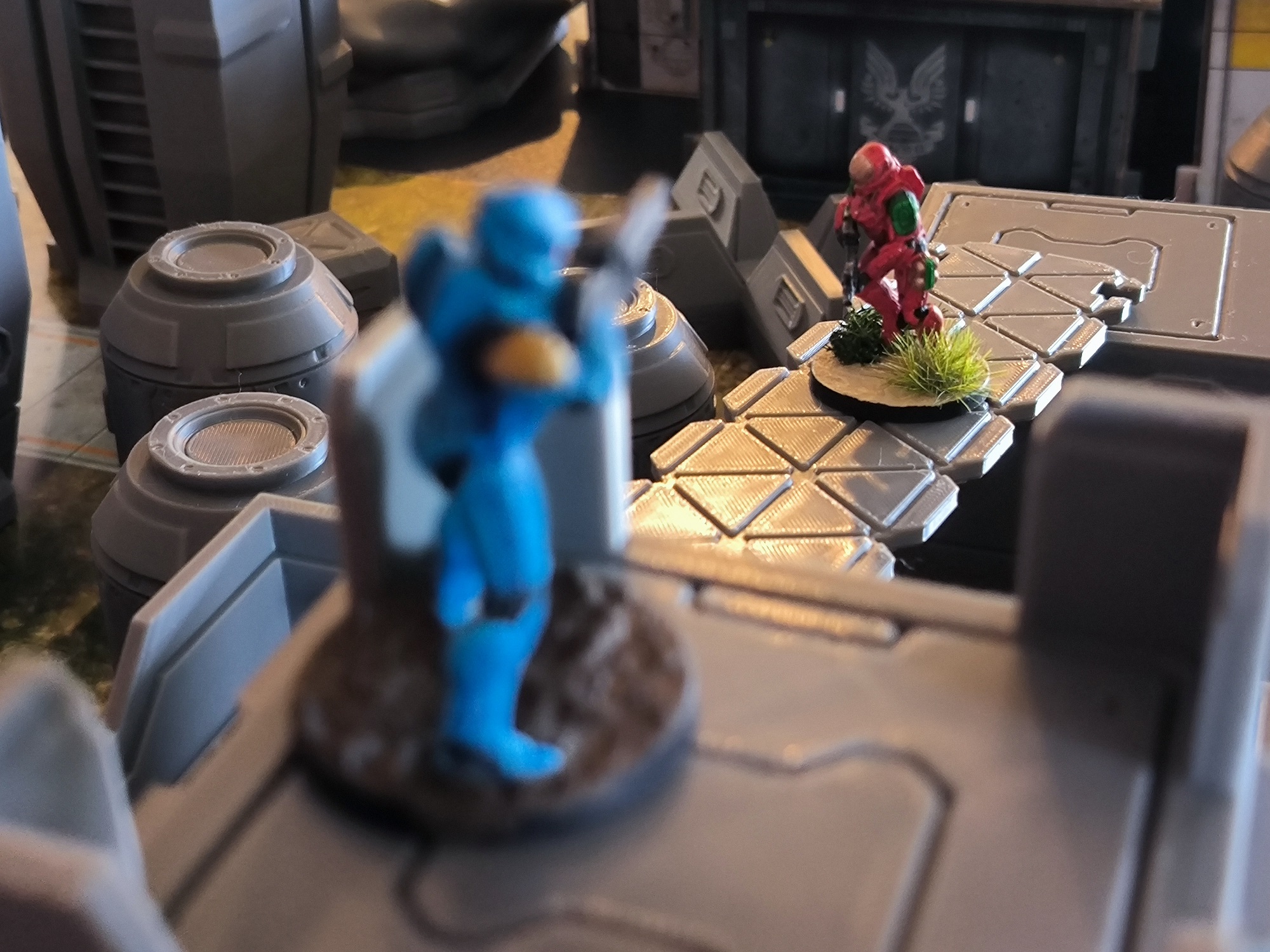
When a fragmentation grenade detonates or the Hydra weapon strikes, models often don’t just die from the shrapnel—they’re sent flying high into the air. This “Forced Movement” adds a dash of wonderful chaos, but above all, it brings some hard-hitting tactical options. I absolutely love using these rules to force tenacious opponents out of their safe cover—or to literally push them off a cliff.
Today we’ll take a look at how grenades wreak havoc on the battlefield, what happens when Spartans slam into walls, and why gravity can be your best friend.
1. “Ask Incoming!”: How Explosions and Deviation Work
When I use a weapon with the keywords “Explosive” or “Grenade” (like a classic Frag Grenade), it works differently than a normal shot. I designate adice-shaped target. The great thing about grenades: I don’t even need a direct line of sight (LoS)! As long as I can see the top of the playing field, I can just lob the thing over a wall.
- The Roll: I make an unmodified test using 3 dice against my Ranged Attack skill (requiring a success).
- Success: The grenade lands right in the dice.
- Miss: Now the scatter mechanism comes into play. I roll a single dice and consult the scatter chart to see which adjacent dice the grenade will drift into. Important: Grenades bounce off solid walls or the edge of the playing field and then come to rest in the dice directly in front of them.
The Damage and the “Push Effect”
Once the detonation cube is set, the dice are rolled. On a roll of 5, I roll 5 dice against the defense (Survive) of every model in that square (yes, even my own!). The difference between the success counts determines the hits.
But here’s the real kicker: If the Frag explosion scores at least as many or more hits as the surviving model’s Survive roll, the hit fighter is knocked to the ground (Pinned) and, due to the force of the explosion, is flung one dice-space in a random direction (Scatter)!
(Note for tacticians: Weapons with the “Implosion” keyword only deal damage to models—they don’t fling them around!)
2. Ouch! When Spartans Slam Into Walls
So what happens if my opponent blows up a model so skillfully that its trajectory is blocked by a solid wall or a barricade? The model stays where it is on the dice, but the wall strikes back!
A brutal crash test is about to take place:
- The opposing player rolls 4 dice for a 4+ on behalf of the wall.
- I’m rolling a Survival check with 3 dice for my flying Spartan.
The result: If the wall scores more successes, my model will definitely be knocked to the ground (pinned) and take hits equal to the difference. The good news for me: The wall has no Armor Piercing (AP), so my armor helps me here. If I win the roll or it’s a tie, I simply shrug off the impact.
3. The Deep Fall: When the Ground Vanishes Beneath Your Feet (Falling)
Halo: Flashpoint thrives on verticality. If a model lands in a dice that simply has no bottom—due to an explosion (or a careless step), for example, because it was hurled over the edge of a platform—gravity takes over. The model immediately falls straight down until it lands on a dice with a bottom.
This is going to be painful, too. Gravity is rolling the dice against you, and the deeper you fall, the more dice it uses:
- 1 the dice rolled low: No test needed—the Spartan lands gracefully.
- 2 dice have fallen a long way (e.g., from level 3 to level 1): Gravity drops 4 dice (on the 4+).
- 3 dice have fallen to the bottom: Gravity drops 5 dice.
My falling model holds its own with a Survive roll of 3 dice.
The result: If gravity wins, the model is pinned and takes damage equal to the difference (again, without AP (armor)). If I win or it’s a tie, I land safely but am still marked as pinned.
What’s especially nasty: If the fall ends on a narrow ledge (half-cube), I first have to roll a 1–8 to see if I can hold on (on a 5–8) or fall even further (1–4). Furthermore, a fall immediately ends any further movement of the model during that action!
My take on your matches
Chain reactions are an extremely important aspect of Flashpoint. According to the rulebook , explosions always take absolute priority over all other effects. First, fragmentation damage is resolved; then the miniatures are flung away; and finally, it’s determined whether they fall or slam into walls.
I use these mechanisms specifically as a strategic tool:
- Breaking Cover: Is an enemy Elite Spartan taking perfect cover and shooting me to pieces? I’ll throw a grenade behind him. Even if the shrapnel doesn’t penetrate his shields—if the scatter throw flings him out of cover and into the open, he’ll be an easy target for my snipers on his next turn.
- Use the Cliff to Your Advantage: If an opponent positions themselves too close to an edge on Level 2 or 3, it’s an open invitation. A well-aimed warhead will send them plummeting into the abyss. The fall damage often finishes them off, and even if they survive, they’ll be pinned and have lost valuable movement.
Transparency notice on the use of AI (in accordance with the EU AI Act):
The content of this blog is personally conceived, researched and defined by me. I use generative artificial intelligence to help me formulate and structure the texts.
Why? This enables me to prepare complex issues more precisely and to focus fully on the quality of the content and research. The final editorial control and responsibility for all published content lies solely with me.
Together for better content!
This blog is a project of the heart that can only continue to grow with your help. Every comment, every recommendation – and especially your financial support – secures the future of this platform.
Do you want this content to remain freely accessible?
This is how you can support the mission:
- NEWSLETTER REGISTRATION: Become part of the fast-growing community and never miss an update again!
- BECOME A PATREON MEMBER: Join the inner circle and get access to exclusive material and early releases.
- OTHER SUPPORT: Whether it’s a donation, sharing a post or recommending the blog to others – every form of support counts!
Let’s make this blog an even better place together!
Ich bin Sören Spieckermann, der Kopf hinter mechstrategen. Seit Jahren faszinieren mich taktische Tabletop-Schlachten und die strategische Tiefe von Mechs. Ob schnelle Gefechte in Halo: Flashpoint oder epische Schlachten bei BattleTech Alpha Strike – hier teile ich meine Erfahrungen und Taktiken mit dir. Mein Ziel? Sowohl Einsteigern den Start zu erleichtern als auch alten Hasen neue Impulse für das nächste Match zu geben.