When we talk about BattleTech Alpha Strike, we usually discuss the best unit combinations, the perfect use of jump jets or the optimal balancing of clan technology against the Inner Sphere. But one crucial factor is often overlooked before the first miniature is even set up: The playing field size!
Is there an optimum size for the play pen?
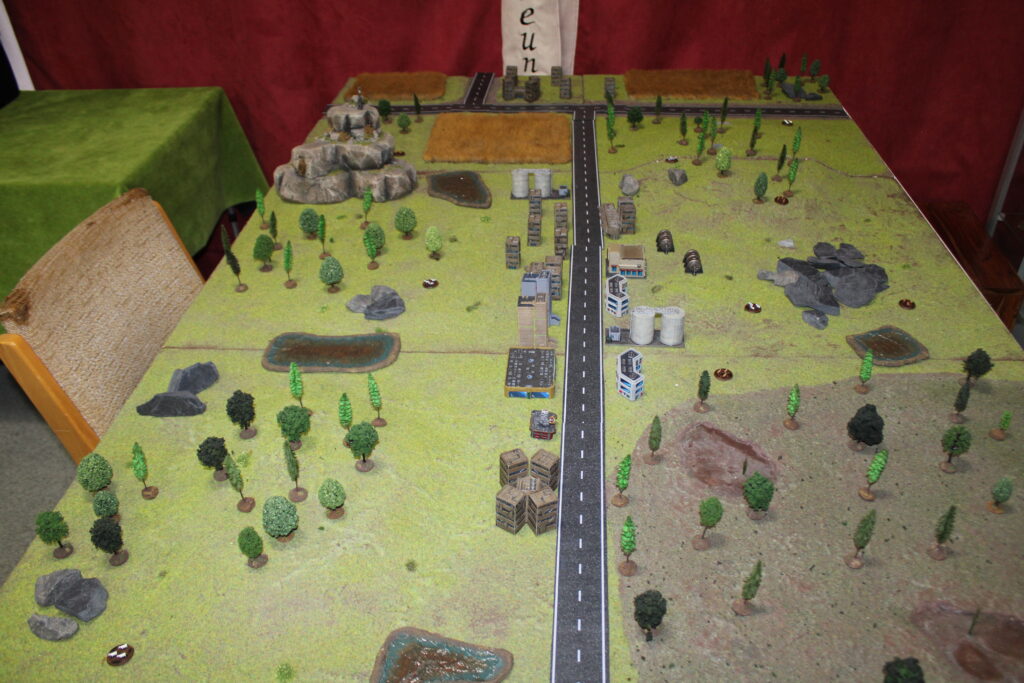
The dimensions of your table are not a purely cosmetic detail. They fundamentally determine which lances or stars shine and which tactics have any chance of survival. Today I would like to explain why the size of the playing field dictates your strategic decisions. And why I personally am an absolute advocate of the classic 4×6 foot (approx. 120 x 180 cm) battlefield. and in short: there is no such thing as the optimum pitch size. However, the pitch size does have some effects.
The wide open spaces: Why I love large pitches (4×6 feet)
If you play Alpha Strike primarily on smaller tables, you will miss out on an essential dimension of the game: real operational mobility. The more space available, the more powerful maneuvers based on speed, flank movement and space gain become.
On a 4×6 foot table, you can outmaneuver your opponent psychologically and spatially instead of simply exchanging statistical damage values head-on. Two classic military tactics unfold their full effect here:
1. the “hammer and anvil” tactic
This tactic is as old as warfare itself, but requires space to deploy. A tough, heavily armored squad (the Anvil, e.g. an Assault Star or a heavy Fire Lance) ties up the enemy main force in the center or at a key position. Meanwhile, a fast, mobile flanking unit (the Hammer, e.g. fast Hovercrafts or extremely agile Medium Mechs) takes advantage of the wide space of the 4×6 table to bypass the enemy and thus fall in the rear.
2. the tactics of the “inner line”
If you are outnumbered on a large field (classic: Clan vs. Inner Sphere), the space allows you to play on the inner line. You use your central position and superior speed to mass your scattered forces at one point faster than your opponent can do on the outer lines. You hit the isolated parts of the enemy army one after the other before they can support each other. On a small field, the enemy units are already so close together that this time and space delay does not even occur.
Tight spaces, tough battles: tactics for smaller pitches (e.g. 3×3 feet)
Smaller tables, such as the occasionally used 3×3 format, are by no means bad. They just drastically change the meta. The scope for wide evasive maneuvers is extremely limited here. If you try to dart across the flank with light mechs, you’ll usually be hit by deadly fire on turn 1 or 2, as the range of the weapons covers almost the entire field.
The “ Oblique Order of Battle” triumphs here.
As you can hardly evade your opponent on a narrow field, you deliberately deny him a flank. You deploy your units asymmetrically: One flank is massively overloaded (e.g. with your absolutely strongest melee and brawler mechs), while the other flank is extremely thinly manned or completely held back.
- The aim: You roll over your opponent’s weaker side with brutal, concentrated force before his other side can intervene to help.
- The advantage on small tables: The opponent has no room to retreat from your clenched fist or to let the attack come to nothing with wide dodging movements.
The direct comparison: space vs. confinement
To clarify the differences for your next army list, I have compared the core aspects here:
| Strategic factor | Large playing field (4×6 feet) | Small playing field (3×3 feet / 2×3 feet) |
| Meaning of Tempo (MV) | Extremely high. Fast units pay back their points by gaining space. | Moderate. High speed is more for generating TMM (Target Movement Modifier). |
| Ranged combat range | Long-range weapons (LRMs, Gauss) are dominant over several rounds. | Units are extremely fast in short or medium range; ranged combat phases are short. |
| Preferred mech classes | Balanced mix. Light/medium mechs indispensable for maneuvers. | Heavy and super-heavy mechs (assaults). Pure firepower and armor reign. |
| Dominant tactics | Hammer & anvil, hit-and-run, delay battles. | Skewed battle formation, deathball (massing of all forces), frontal attrition fight. |
My conclusion for your tabletop rounds
The rule of thumb for your games should be: Choose your army to match the table.
If you are playing on a large 4×6 foot table, stay away from pure, slow “stand swashbucklers”. Pack fast Scouts, Hovercrafts or agile Mediums to use the space as a weapon. If your local club or kitchen table is only 3×3 feet or less, stop dreaming of elegant flanking maneuvers. Go for solid armor, refuse to flank with the lopsided battle formation, and look for the hard, fast exchange of blows.
Transparency notice on the use of AI (in accordance with the EU AI Act):
The content of this blog is personally conceived, researched and defined by me. I use generative artificial intelligence to help me formulate and structure the texts.
Why? This enables me to prepare complex issues more precisely and to focus fully on the quality of the content and research. The final editorial control and responsibility for all published content lies solely with me.
Together for better content!
This blog is a project of the heart that can only continue to grow with your help. Every comment, every recommendation – and especially your financial support – secures the future of this platform.
Do you want this content to remain freely accessible?
This is how you can support the mission:
- NEWSLETTER REGISTRATION: Become part of the fast-growing community and never miss an update again!
- BECOME A PATREON MEMBER: Join the inner circle and get access to exclusive material and early releases.
- OTHER SUPPORT: Whether it’s a donation, sharing a post or recommending the blog to others – every form of support counts!
Let’s make this blog an even better place together!

Ich bin Sören Spieckermann, der Kopf hinter mechstrategen. Seit Jahren faszinieren mich taktische Tabletop-Schlachten und die strategische Tiefe von Mechs. Ob schnelle Gefechte in Halo: Flashpoint oder epische Schlachten bei BattleTech Alpha Strike – hier teile ich meine Erfahrungen und Taktiken mit dir. Mein Ziel? Sowohl Einsteigern den Start zu erleichtern als auch alten Hasen neue Impulse für das nächste Match zu geben.