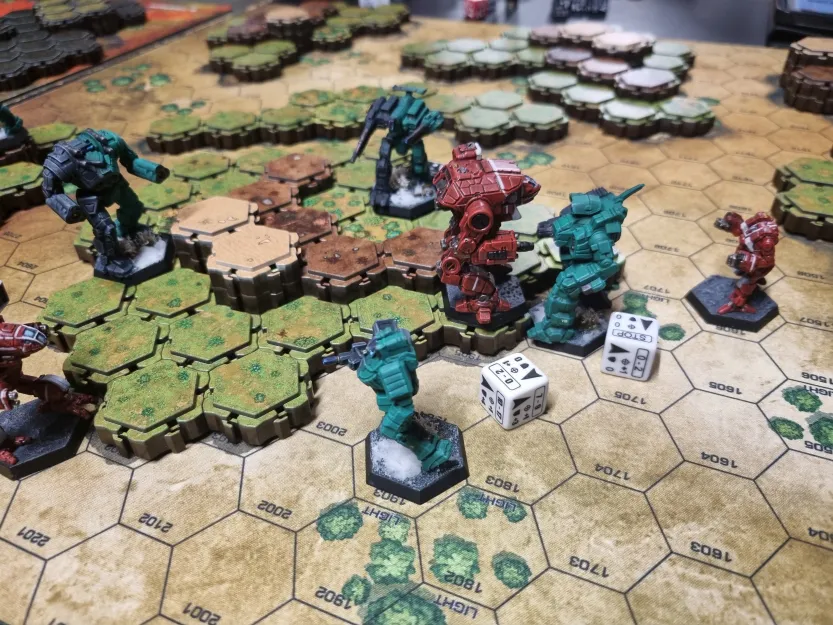
5 amazing facts about the BattleTech universe (and why it’s darker than Star Wars)
With the renewed success of Catalyst Games Lab’s strategy game, the BattleTech universe has recently returned to the spotlight. For many, it’s a fascinating setting full of giant battle robots, but what exactly sets this world apart from more well-known science fiction universes such as Star Wars or Star Trek?
The answer is more surprising and far bleaker than many might expect. Instead, it is a bleak glimpse into a feudalistic future-feudalism in which humanity does not ascend to the stars, but collapses under the weight of its own unending history.
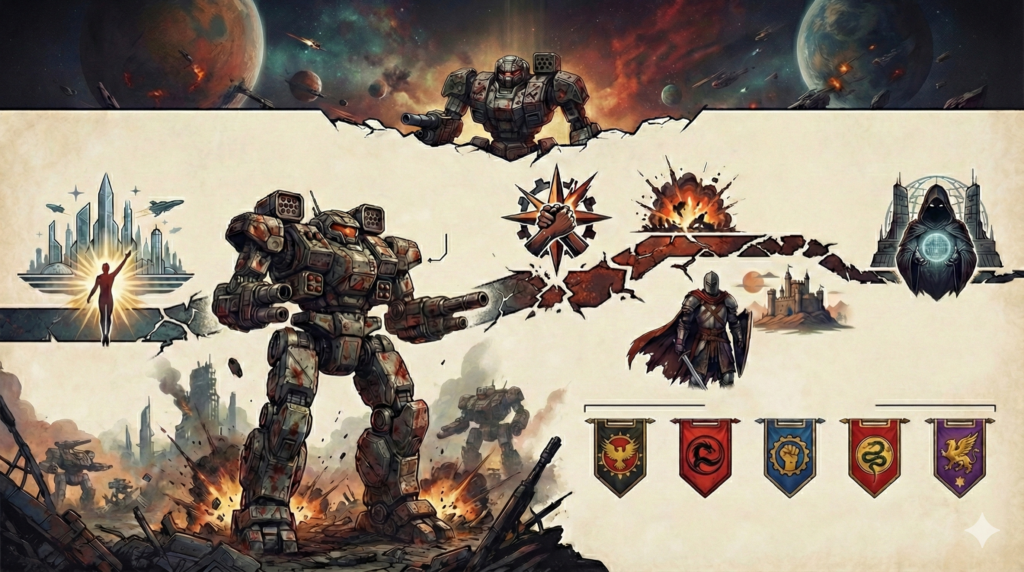
The 5 most important findings
Point 1: It’s about war. Only about war.
In contrast to Star Wars, which is essentially a fantasy tale about the battle of good versus evil, BattleTech is all about the never-ending human conflict. There is no simple moral division, no diplomatic panacea as in Star Trek, whose humanistic world view often allows for a peaceful solution. Crucial to the gloomy atmosphere is that the war itself is the central premise, not the journey of a single hero.
The name says it all: the eternal conflict is the driving force behind the narrative, and the 15-meter-high BattleMechs are its ominous icons.
Point 2: Welcome to the new dark ages of space.
What makes BattleTech fundamentally different from other science fiction is its social regression into a system that is strikingly similar to the European Middle Ages. Instead of progressive republics, humanity has reverted to an archaic structure.
- Feudal lords: The five great star empires – the United Suns (House Davion), the Draconis Combine (House Kurita), the Lyran Commonwealth (House Steiner), the Capella Confederacy (House Liao) and the League of Free Worlds (House Marik) – are not ruled by parliaments, but by noble families. Intrigues, successions and dynastic conflicts are strongly reminiscent of Game of Thrones.
- Knights: The MechWarriors, the pilots of the giant BattleMechs, are the modern knights of this era. They are the elite warriors whose loyalty and fighting power decide the fate of entire planets.
- The Church: The mysterious organization ComStar controls all interstellar communication through its monopoly on the so-called hyperpulse generators. Much like the Catholic Church controlled knowledge in the Middle Ages, ComStar uses its power to influence the Great Houses. This quasi-religious structure is emphasized by the fact that its followers even say prayers when they operate their machines.
This medieval structure is key to the political drama of BattleTech. It replaces the simplistic ideological conflicts of other science fiction worlds with a personal and insidious landscape of dynastic ambition, betrayal and honor more reminiscent of a historical epic.
Point 3: Technology has taken a step backwards.
In most science fiction worlds, technology advances inexorably. BattleTech goes the opposite way and introduces the concept of “technology loss” (Lostech). After the collapse of the golden age, the era of the “Star Alliance”, mankind lost the knowledge to produce many advanced technologies.
The Succession Wars that followed were so devastating that they ravaged civilization for 300 years. With “tens of billions of deaths” and the obliteration of entire planets, the technological level on many worlds was set back to that of the 21st century. This is a powerful narrative device that subverts the typical sci-fi narrative of progress. It creates a sense of scarcity and desperation that makes any ancient BattleMech or salvaged piece of technology immeasurably valuable and significant – akin to a legendary sword in a fantasy saga.
Point 4: A grounded universe without aliens, but also without the internet.
BattleTech draws its unique texture from a fascinating paradox: it is simultaneously more grounded and more outdated than its counterparts. On the one hand, the setting deliberately tries to be based on “real physics and science”. Typical sci-fi elements are completely absent here: There are no aliens, no teleportation and no energy shields. This gives the battles weight and consequence.
On the other hand, the universe is a charming product of its time of origin in the 1980s. This leads to anachronisms that reinforce the “lost golden age” theme. Weapons have an unrealistically short range of less than a kilometer, and a concept like the Internet does not exist. This outdated technology keeps conflicts personal and planetary instead of making them abstract and galactic.
Point 5: There are no “good guys”.
Perhaps the most important point is the moral complexity of BattleTech. There is no clear distinction between heroes and villains, as we know it from Star Wars. Instead, there are only “different points of view”. Each of the Great Houses has its own motives, its own culture and its own sins.
This moral ambivalence is a direct consequence of the feudal structure described in the second point. In a world of competing noble houses, there is no “rebellion” fighting for universal freedom against a monolithic “empire”. Instead, there are dynasties, each with their own legitimate history, culture and grievances, making the conflicts infinitely complex and tragic. Even the most militarized factions actually “make sense in some way” from their perspective.
Conclusion: A gloomy future to think about
The enduring fascination of BattleTech lies in its unique blend of feudal drama, the decline of technology and a ruthless realism about human nature. Ultimately, BattleTech is not a story about the future, but a bitter allegory for the present: a warning that while technology can take us to the stars, it will not save us from ourselves.
In a future characterized by endless war and past glories, what does it mean to be human?
BattleTech paints a picture of a future that is far from utopian. The focus on human abysses, the constant battle against technological decay and a political landscape with no easy answers make it one of the most complex and mature science fiction universes ever. It is a world that reminds us that the greatest monsters often lurk not among the stars, but within ourselves.
In a universe without shining heroes, which of the flawed Great Houses would you fight for?
Transparency notice on the use of AI (in accordance with the EU AI Act):
The content of this blog is personally conceived, researched and defined by me. I use generative artificial intelligence to help me formulate and structure the texts.
Why? This enables me to prepare complex issues more precisely and to focus fully on the quality of the content and research. The final editorial control and responsibility for all published content lies solely with me.
Together for better content!
This blog is a project of the heart that can only continue to grow with your help. Every comment, every recommendation – and especially your financial support – secures the future of this platform.
Do you want this content to remain freely accessible?
This is how you can support the mission:
- NEWSLETTER REGISTRATION: Become part of the fast-growing community and never miss an update again!
- BECOME A PATREON MEMBER: Join the inner circle and get access to exclusive material and early releases.
- OTHER SUPPORT: Whether it’s a donation, sharing a post or recommending the blog to others – every form of support counts!
Let’s make this blog an even better place together!

Ich bin Sören Spieckermann, der Kopf hinter mechstrategen. Seit Jahren faszinieren mich taktische Tabletop-Schlachten und die strategische Tiefe von Mechs. Ob schnelle Gefechte in Halo: Flashpoint oder epische Schlachten bei BattleTech Alpha Strike – hier teile ich meine Erfahrungen und Taktiken mit dir. Mein Ziel? Sowohl Einsteigern den Start zu erleichtern als auch alten Hasen neue Impulse für das nächste Match zu geben.