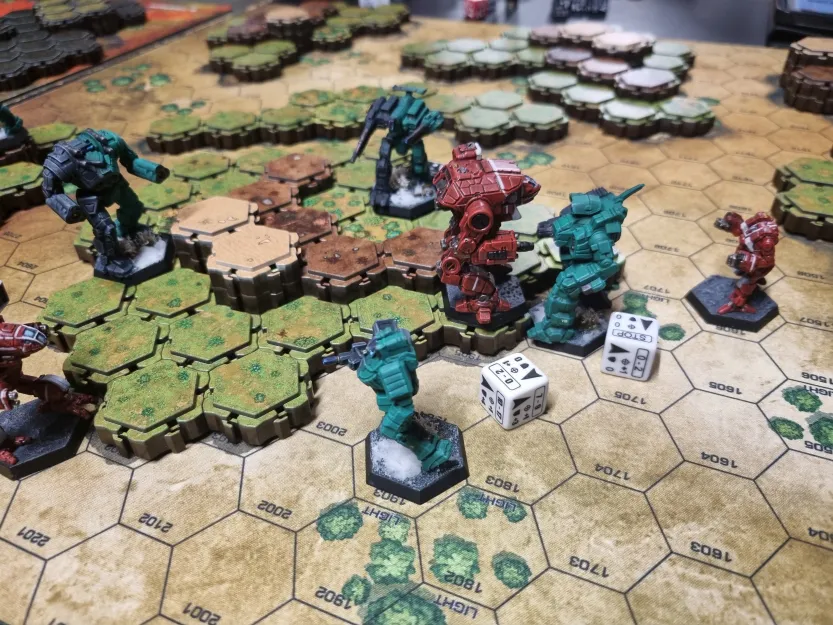
Strategy or storytelling? The fascinating gap between competitive and narrative Alpha Strike
Beyond Point Values: Where naked strategy meets the soul of Lore.
Sooner or later, every wargamer is faced with a fundamental decision at the gaming table: Do you want the challenge of tough, fair competition, where every tactical mistake can spell doom? Or would you rather be swept away by an epic, unpredictable story where the outcome is secondary to the experience?
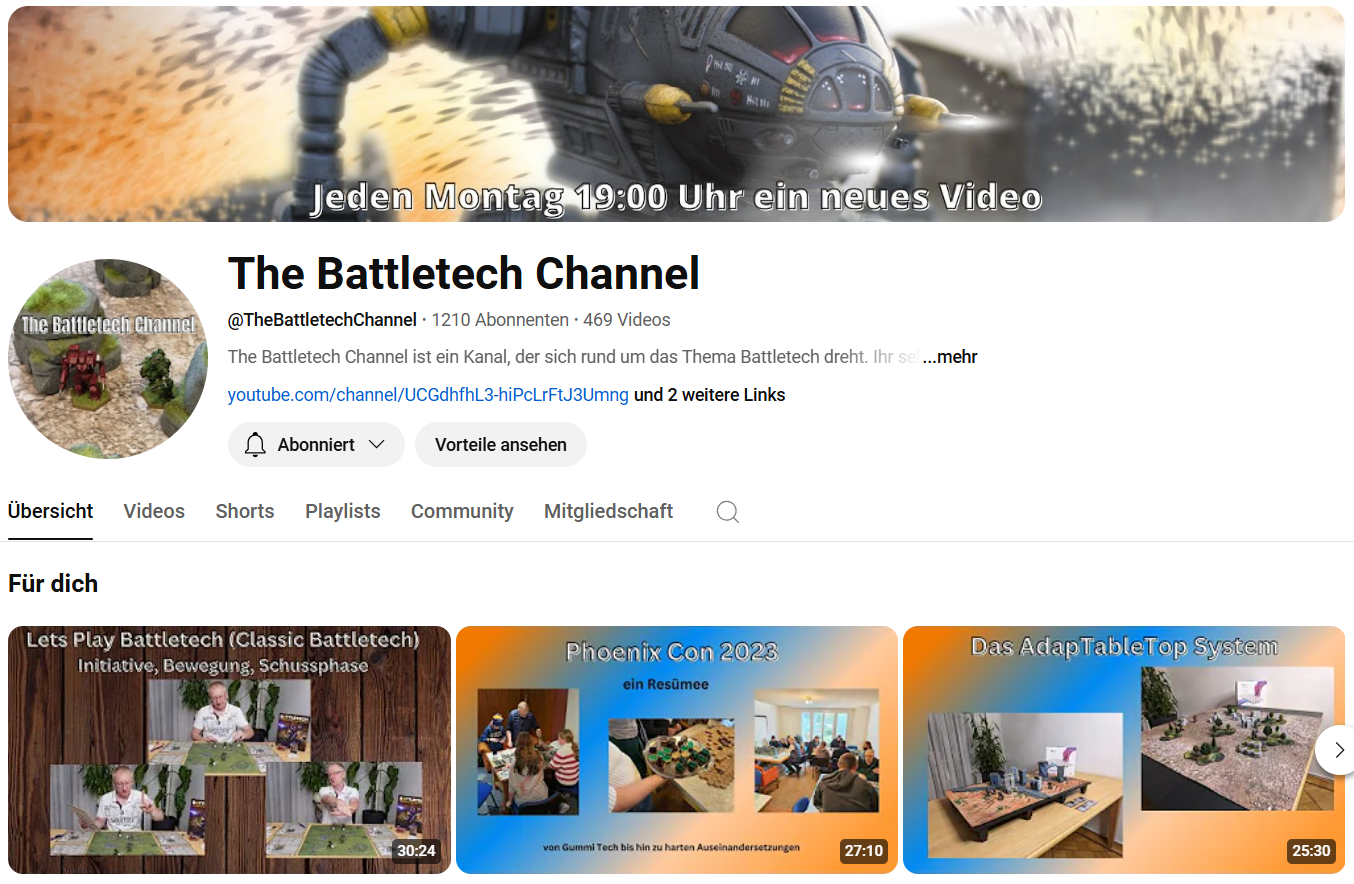
The suggestion to deal with this dynamic in detail came from a recent contribution by Carl Walmsley on YouTube. His thoughts on the subject led me to examine this area of tension specifically for our Alpha Strike tables. It’s the classic dilemma between the pursuit of strategic triumph and the desire for deep immersion in the BattleTech universe. While some find fulfillment in the precise execution of a battle plan, others seek the adventure that evolves organically from the Lore.
The pillars of the competition: symmetry and sporting fairness
In the competitive Alpha Strike, game balance is the highest good. The goal is clearly defined: Both players should start the game with exactly the same prerequisites, so that in the end, tactical skill and a little bit of luck with the dice alone decide who wins or loses.
Point values (PV) are the basis for this. In a competitive environment, a fixed point limit is agreed – around 250 or 300 PV. Since every unit, every pilot skill and every special attribute has a fixed value, this ensures that the armies are equally strong on paper. But the symmetry doesn’t stop there. For a truly competitive experience, external factors must also be taken into account:
- Terrain design: A fair table offers both sides similar coverage options and lines of sight. No one should gain a massive advantage simply by choosing the side of the table.
- Mission objectives: The objectives are designed in such a way that they are achievable for both army types (whether fast flankers or heavy besiegers). Symmetrical scenarios are often used in which both sides receive the same points for holding markers or destroying enemy mechs.
In this mode, each side has the same theoretical chance of victory at all times. That’s what makes it so appealing: It’s a mental duel, a “sport” with mechs, where the rules provide the framework for a fair comparison.
Why narrative games celebrate the “unjust” story
Narrative game systems take a completely different approach. Here, the story takes center stage, which means that the game balance is often deliberately ignored or even actively undermined. The aim is not to fight a “fair” battle, but to replay an episode from the history of the 31st century – and history is rarely fair.
In a narrative scenario, a small, battered lance of Inner Sphere mechs may be trying to hold a strategically important mountain pass against an invading clan star. The PV values are often completely disregarded here. The tension comes not from the question “Who has the better list?” but from the question: “How long can my pilots hold out before the superior force overruns them?”
This deliberate imbalance creates a dramaturgy all of its own. The rules here serve not as judges of fairness, but as tools to capture the feeling of the Lore. A player may have virtually no chance of a military victory, but he wins on the narrative level when his last mech covers the retreat of the civilians. It’s about creating moments that feel like a novel by Stackpole or Thurston.
Mental bandwidth and social peace at the table
One aspect that is often underestimated is the psychological component. Competitive systems often have a high barrier to entry. Those who only play occasionally often use up their entire mental bandwidth just remembering the precise interactions of special rules and modifiers so as not to make a tactical mistake. The pressure to play “optimally” can be exhausting for casual players. Force building, i.e. the composition of the army, naturally also favors an experienced player.
Here, narrative approaches or cooperative scenarios offer an ideal way out. The relative simplicity of the objectives (e.g. “Reach the other edge of the table”) is easy on the players’ mental energy. It is often a far more positive social experience to stand together as a group against an overpowering threat (or to perish heroically) than to be tactically outclassed by a highly specialized tournament player in three rounds. In the narrative game, “losing” is not a failure of the player, but a dramatic chapter in the story. This promotes social peace and ensures that everyone gets up from the table with a smile.
Asymmetry as a tactical handicap system
If you decide to play with unequal point values – whether for narrative reasons or because the players’ collections are of different sizes – Alpha Strike offers wonderful opportunities to compensate for this asymmetry through targeted adjustments. The story provides us with the justification for the handicap here:
- Strategic mission objectives: The army with more points has a much more difficult objective. While the inferior army only has to “survive”, the superior army may have to capture three specific buildings within four turns without destroying them.
- Terrain advantages: The side with the fewer points can determine the terrain. It can entrench itself in fortified positions, deep forests or behind minefields, which can undermine the numerical superiority of the opponent.
- Rule adjustments as a story element: You can mechanically slow down the superior army. Perhaps it suffers from “insufficient supply” (limited ammunition/special abilities) or “electronic interference” (more difficult hit rolls). The inferior side, on the other hand, could enjoy “home field advantage” and be allowed to move faster through difficult terrain.
This even allows an experienced veteran to play against a complete beginner. The veteran takes on the difficult, inferior side. This keeps the game exciting for both: the rookie can feel the power of his mechs, while the veteran has to use all his skills to complete the impossible mission.
Conclusion: What remains after the game?
Although competitive and narrative Alpha Strike differ in their goals, they are not opponents, but two sides of the same coin. A competitive game gains enormous depth when it is embedded in a fluffy context. And a narrative scenario still needs a functioning rule skeleton so that the actions of the mechs remain comprehensible.
At the end of the day, it’s not just the ranking in a tournament table that counts, but the memory of a moment on the battlefield that will still be a talking point years later. Whether this moment resulted from a perfect tactical flanking move or a desperate last stand is almost irrelevant.
What is decisive for you?
Is it the triumph of the strategic mind that makes a game unforgettable for you, or the story that you still tell over a beer years later?
Transparency notice on the use of AI (in accordance with the EU AI Act):
The content of this blog is personally conceived, researched and defined by me. I use generative artificial intelligence to help me formulate and structure the texts.
Why? This enables me to prepare complex issues more precisely and to focus fully on the quality of the content and research. The final editorial control and responsibility for all published content lies solely with me.
Together for better content!
This blog is a project of the heart that can only continue to grow with your help. Every comment, every recommendation – and especially your financial support – secures the future of this platform.
Do you want this content to remain freely accessible?
This is how you can support the mission:
- NEWSLETTER REGISTRATION: Become part of the fast-growing community and never miss an update again!
- BECOME A PATREON MEMBER: Join the inner circle and get access to exclusive material and early releases.
- OTHER SUPPORT: Whether it’s a donation, sharing a post or recommending the blog to others – every form of support counts!
Let’s make this blog an even better place together!
Ich bin Sören Spieckermann, der Kopf hinter mechstrategen. Seit Jahren faszinieren mich taktische Tabletop-Schlachten und die strategische Tiefe von Mechs. Ob schnelle Gefechte in Halo: Flashpoint oder epische Schlachten bei BattleTech Alpha Strike – hier teile ich meine Erfahrungen und Taktiken mit dir. Mein Ziel? Sowohl Einsteigern den Start zu erleichtern als auch alten Hasen neue Impulse für das nächste Match zu geben.