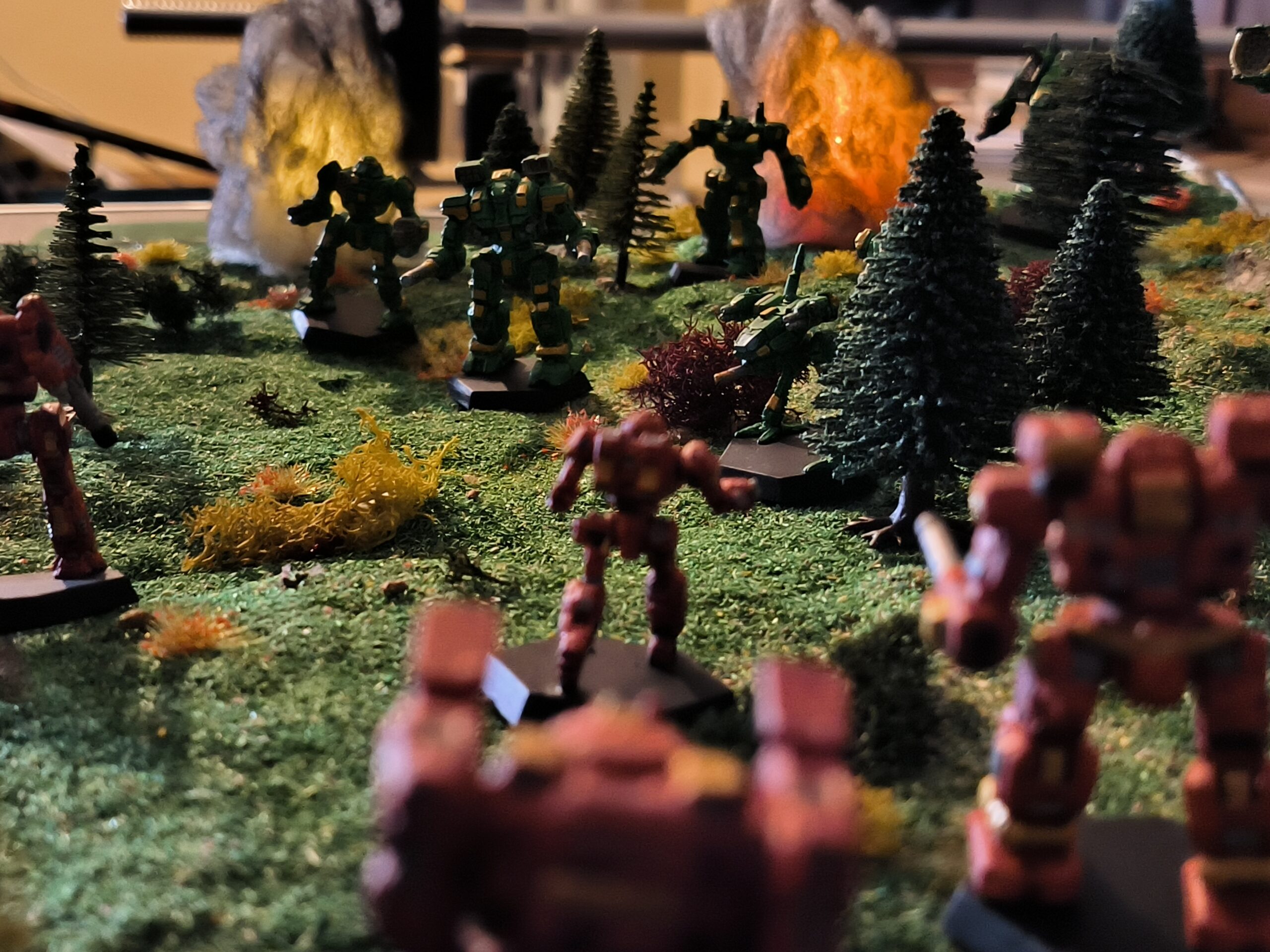
Force Building Deep Dive: Why ENE, CASE and IF make the difference between victory and defeat
We all know that moment in force building: you’ve got a few points left, the tonnage limit isn’t quite reached yet, and you’re staring at the variant list of your favorite mech. Should it be the
Today I would like to talk to you about three specific skills that play a central role in my force-building philosophy: ENE, CASE, CASEII and IF.
All too often these little abbreviations are overlooked, but they are precisely the tip of the scales that decides whether your mech is still standing after a lucky hit from the opponent – or whether it turns into a spectacular fireball.
Survival is everything: The power of ENE and CASE / CASEII
Let’s start with the defense. We all hate it: the lucky crit. You’re still fully armored, standing strong, and then that one shot hits you, smashing through the armor, hitting the ammo and turning your pristine mech into scrap metal.
This is exactly where ENE and CASE/CASEII come into play. When I’m faced with the choice of which variant of a mech to include in my lance, I have one golden rule: safety first.
1. ENE (Energy)
This is the holy grail of survivability. A mech with the ENE ability relies – as the name suggests – exclusively on energy weapons or has no explosive components that can be critically hit.
Why I love ENE: It completely eliminates the risk of an ammunition explosion. Period. If I have a choice between a ballistic variant and an ENE variant, I almost always go for the ENE version. Why risk a roll of 12 on the crit table ending my game? ENE makes your mech tougher, more reliable and takes away the opponent’s chance of the “lucky kill”.
2. CASE (Cellular Ammunition Storage Equipment)
Not every mech can only carry lasers. Sometimes we need autocannons and missiles. This is where CASE/CASEII is your life insurance.
Although CASE does not prevent the munitions from exploding, it channels the force of the explosion in such a way that the rest of the mech (and especially the fusion reactor and the cockpit) are spared.
My tip: If you are force building, take a close look at the variants. Often variants with CASE cost only slightly more (or have the same PV), but offer a massive advantage in durability. A mech with CASE survives the mistake that a mech without CASE pays for with its life.
Tactical flexibility: IF (Indirect Fire)
Let’s move on to the offense. While ENE and CASE are “no-brainers” for the defense, IF (Indirect Fire) requires you to rethink your strategy.
I often see players putting IF units (like the classic Lrm Carrier or Archer) in their list without matching the rest of the army to it. That’s wasted potential. IF is not an ability that you “just pick up” – it’s a commitment to a specific tactic.
When is IF worthwhile?
The ability to deal damage without direct line of sight (LOS) is powerful, but it depends on two factors:
- The terrain: Are you playing on a flat “moonscape”? Then save your points. IF shines where direct lines of sight are scarce. In
dense forests orbuilt-up urban areas , IF is king. You can stand safely behind a skyscraper or mountain and wear down your opponent while he can’t even see you. - The spotters: IF without spotters is like a sniper without a scope – inefficient. If I include a unit with IF in my list, I must also include fast, mobile units (e.g. light mechs, VTOLs or fast hovercrafts) that act as spotters.
My force-building rule for IF: Only take IF if you’re ready to play your lance as a combined team. Your spotter provides the eyes, your LRM boat provides the hammer. If either is missing, the strategy collapses.
Conclusion: The devil is in the detail
Force building is more than just stacking armor and damage. It’s about risk minimization and synergy.
- Minimize the risk: For comparable mechs, always choose the variant with ENE or CASE. There is no logical reason to accept the risk of an ammunition explosion when there is a safer alternative.
- Maximize synergy: Only use IF if the terrain allows it and you have supplemented your list with suitable spotters.
How do you build your lances? Are you risk takers who rely on pure firepower without CASE, or do you plan as conservatively as I do? Let me know in the comments!
Good shot and no jamming!
Greetings Sören from Mechstrategen
Together for better content!
This blog is a project of the heart that can only continue to grow with your help. Every comment, every recommendation – and especially your financial support – secures the future of this platform.
Do you want this content to remain freely accessible?
This is how you can support the mission:
- NEWSLETTER REGISTRATION: Become part of the fast-growing community and never miss an update again!
- BECOME A PATREON MEMBER: Join the inner circle and get access to exclusive material and early releases.
- OTHER SUPPORT: Whether it’s a donation, sharing a post or recommending the blog to others – every form of support counts!
Let’s make this blog an even better place together!