Mastering the Grid – How to plan movements in the Halo: Flashpoint cube system
Spartans, check your equipment! If you’re coming from classic tabletop systems like Warhammer 40k or Star Wars: Legion, your first instinct with Halo: Flashpoint is probably to reach for the tape measure.
But wait! Put the tape measure away.
Halo: Flashpoint (based on the proven system from Mantic Games) uses a mechanic that makes the game faster, more precise and – if you master it – much more tactical: the cube system.
In this article, we dive deep into the “Grid” and show you how to plan moves that flank your opponents and secure the mission objective.

What is the Cube system?
Instead of free measurement (“Move 6 inches in any direction”), the playing field in Halo: Flashpoint is divided into square fields – the so-called cubes.
The special thing about it is its three-dimensionality. A cube is not just a square on the floor mat; it is a virtual dice that goes up. The playing field is therefore a huge grid of 3x3x3 inch dice.
Why is that brilliant?
- No discussions: There’s no “Am I still in range?” or “Is that 5.9 or 6 inches now?”. You’re either in the Cube or you’re not.
- Speed: The game is extremely accelerated as there is no need to fiddle with templates and measuring tapes.
- Tactical clarity: You can calculate moves perfectly in advance (similar to chess).
Mastering movement: how it works
Each model has a movement stat, which indicates how many cubes it can move per action.
Counting the steps
Movement always takes place in adjacent cubes. This means:
- Orthogonal: forwards, backwards, left, right.
- Diagonal: Permitted as long as the path is not blocked.
If your Spartan has a move stat of 1-3, he may move 1 cube if he uses a short action. Or 3 cubes if it uses the long action.
Movement for advanced users (diagonal & vertical)
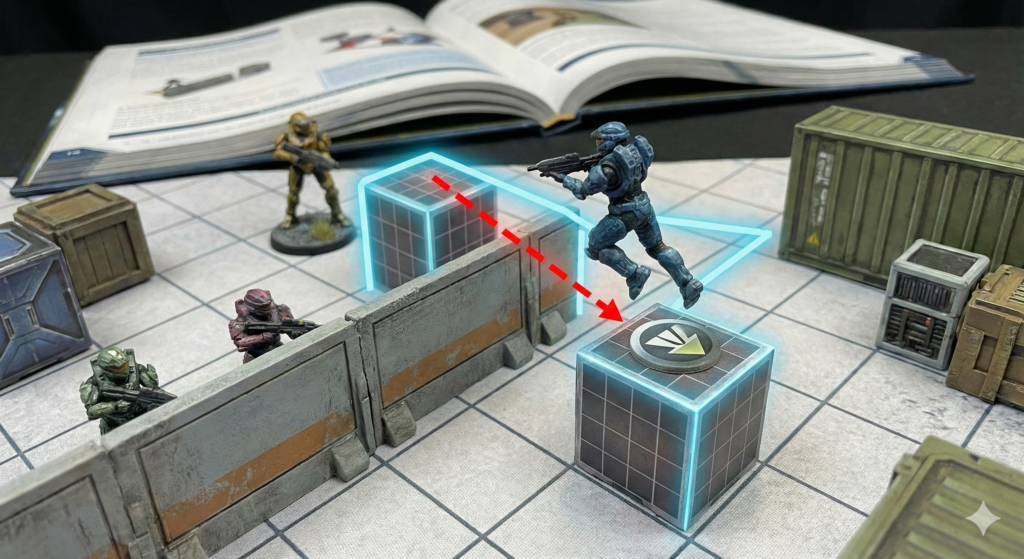
This is where the wheat is separated from the chaff. The grid system allows diagonal moves – even upwards.
Movement on the same level: Will the Spartan fit through?
Even if you only move from one cube to the next on the same level, the path is not always automatically free. Movement is checked along the shortest orthogonal path, which must not be completely blocked by terrain.
- The reality check: The side of the cube you want to cross must offer enough free space for your model to fit over, under or through it. You cannot walk through a solid steel wall (unless you have very special equipment!).
- The 50% rule: How big must a hole in the wall be? As a rule of thumb, a gap (e.g. a destroyed window or a crack in the wall) must cover at least 50% of the total area of the wall side so that a model can squeeze through.
- Before the game (pro tip): Take a good look at your terrain before you start the first round. Briefly agree with your opponent: “Does this window count as a passage? Can you get under the pipe here?” This saves time and nerves once the plasma shots start flying!
Parkour for Spartans: climbing and jumping
Spartans don’t need ladders. We climb walls.
- Change level: All cubes directly above or below you are considered “adjacent”.
- Jumping down: Jumping down one level (onto a floor) is free and does not count as a fall. Anything lower than 1 level requires climbing (otherwise fall damage!).
- Climbing up: To climb upwards (including diagonally), a wall, ladder or ledge must be within reach.
- Vertical up: You need a wall/edge in the start cube.
- Diagonal up: Align your model to the target. Check the orthogonal path (in front -> side -> up). Is there a wall at your starting position or along the path that creates a connection to the target? If the only wall is behind your back, you cannot logically use it to jump forward upwards.
The same applies to diagonal climbing: you do not interact with enemies or items on the “test path” in the air. You move directly to the goal.
Retreat from close combat (Break Away)
Sometimes a strategic retreat is better than an honorable death. If you want to leave a cube containing enemy models, you can do so with a normal Advance Action. But this comes at a price!
- Before you move, your opponent may choose one of his units in this cube to perform a free Assault Action against you (Fight Test against your Survive Test).
- If you survive this “parting shot” (i.e. you are not killed or pinned), your break away is successful and you may continue your movement.
- Important: If the opponent in the cube is already pinned (held down), he is out of luck. A pinned model cannot perform the free assault action – so you can safely pass him by!
Tactics guide: How to use the grid to your advantage
The cube system is not just a movement aid, it is your most important source of information for cover and line of sight.
The “busy” rule
Free choice of position: If you end your movement in a cube, you can place your model anywhere within this cube. You don’t have to stand stubbornly in the middle. Take advantage of this! Place your Spartan directly against a wall or barricade within the cube to make it visually clear that you are using the cover.
The cube limit (it’s getting tight!): It can get cuddly, but never chaotic. A single cube can accommodate a maximum of four models at the same time. The division is strict: up to two friendly units and up to two enemy units. If Spartans etc. share a cube, this inevitably means one thing: intense close combat.
Calculate ranges without measuring
Weapon ranges are also measured in cubes.
- Example: A weapon with range 5 reaches everything that is 5 cubes away.
- The trick: You can count out exactly before you move: “1, 2 steps here, then I’m 4 cubes away from the opponent -> hit zone.” This eliminates the risk of announcing an attack that then narrowly fails.
Grid blocking (blocking the path)
Since models (depending on their size) can occupy cubes and block the passage of enemy models, you can use the grid to create chokepoints.
- Place a resistant Spartan in a narrow corridor. The opponent cannot pass through your cube (unless he can fly or has special rules). You force him to take detours or engage in close combat.
High ground is king: the sniper position
In Halo, things often go upwards, and the cube system rewards vertical thinking massively.
- The advantage: If you shoot from a higher cube at a target in a lower cube, you receive a bonus die on your attack.
- The tactic: Park your sniper on a turret or container stack. The grid makes it easy for you to check the lines of sight (LOS) over the entire battlefield. You control huge corridors from up there and force the enemy to stay in cover.
The “buddy system” in close combat
Remember the cube limit (two friendly units, two enemy units)? That’s not just a space restriction, it’s an invitation to a coordinated attack!
- The rule: If a model performs a Fight Action and there is another friendly model in the same cube (that is not pinned ), the attacker receives a bonus die for the melee.
- The tactic: Never send Spartans alone into close combat against an elite warrior. Move the first Spartan into the opponent’s cube (to bind it) and then move the second Spartan in to deliver the devastating blow with bonus dice. Teamwork kills!
Precise “Objective Play”
At the end of the day, you usually win Flashpoint through mission objectives, not just kills. The grid takes the stress out of this.
- The tactic: To claim or fight over a mission objective, you must be in the same cube. There is no debate about whether your base is touching the objective. Plan your last move in the game exactly: “I need 3 movement points to land in this exact cube and win the game.” The grid allows you this surgical precision in the last round.
Conclusion: Order in the chaos of battle
Halo: Flashpoint ‘s cube system may seem like a simplification at first glance, but it quickly reveals itself to be a powerful tool for strategic depth. It removes the gray areas of tabletop – the constant measuring, discussing and estimating – and replaces them with hard tactical facts.
Those who master the grid not only play faster, but also more deadly. You know exactly whether you can hit. You know exactly whether you are in cover. And you know exactly how risky it is to retreat from close combat.
Stop thinking in inches and centimeters. Start thinking in vectors, height planes and cube limits. That’s the way a Spartan designs a battle plan.
Transparency notice on the use of AI (in accordance with the EU AI Act):
The content of this blog is personally conceived, researched and defined by me. I use generative artificial intelligence to help me formulate and structure the texts.
Why? This enables me to prepare complex issues more precisely and to focus fully on the quality of the content and research. The final editorial control and responsibility for all published content lies solely with me.
Together for better content!
This blog is a project of the heart that can only continue to grow with your help. Every comment, every recommendation – and especially your financial support – secures the future of this platform.
Do you want this content to remain freely accessible?
This is how you can support the mission:
- NEWSLETTER REGISTRATION: Become part of the fast-growing community and never miss an update again!
- BECOME A PATREON MEMBER: Join the inner circle and get access to exclusive material and early releases.
- OTHER SUPPORT: Whether it’s a donation, sharing a post or recommending the blog to others – every form of support counts!
Let’s make this blog an even better place together!