
A History of the Federated Suns (2317-3152)
The Legacy of New Avalon: A History of the Federated Suns (2317-3152)
An analytical look at political evolution, military resilience and the social paradox of the House of Davion.
1 The laying of the foundation stone: From the Crucis Pact to centralization
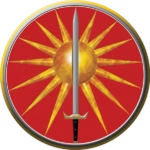
The history of the Federated Suns does not begin with a campaign of conquest, but with a stroke of diplomatic genius. When Lucien Davion signed the Crucis Pact in 2317, he took advantage of New Avalon’s strategic position as the “breadbasket” of the region. The dependence of the surrounding worlds on New Avalon’s agricultural goods formed the economic foundation for the political supremacy of House Davion.
The transition from a loose alliance of sovereign worlds to a centralized state was a process of calculated power shift. Originally conceived as a representative democracy in which a High Council elected the president, the Davions systematically eroded the powers of this body. The immense time delay in interstellar communication was used as an excuse to place decision-making powers in the hands of the President. The High Council degenerated into a rubber-stamp body, while the Privy Council, later strengthened by Alexander Davion, became the actual center of power. This effectively transformed the presidency into a hereditary monarchy, which remained firmly in the hands of the House of Davion.
The contradiction of freedom: the “Six Liberties”
The Crucis Pact guaranteed six fundamental rights:
- The right to personal freedom
- The right to property
- The right to bear arms
- The right to fair treatment
- The right to privacy
- The right to participate in planetary government
Herein lies the central paradox: while these rights were often preserved at local level, a neo-feudalism was established at state level. The population accepted this contradiction, as the nobility usually acted wisely enough to respect the will of the people as long as taxes were paid. This internal stability through local autonomy, coupled with a warlike elite, prepared the Federated Suns for the coming centuries of expansion and struggle for survival.
2 The evolution of power: the reforms of Simon and Alexander Davion
As the empire expanded, the administration became increasingly complex. In 2418, Simon Davion formalized the division of the empire into five “marches” (brands) in order to decentralize defence and administration. However, it was Alexander Davion who drew the necessary conclusions after the devastation of the Davion Civil War. He broke up the Terran and Outer Marches in order to break the power of the rival princes and cement the First Prince as the undisputed commander-in-chief.
The administrative transformation of brands
| Original brand (2418) | Status after the Alexander reforms | Strategic relevance in the 32nd century |
| Crucis March | Central dominion | Core sector; home of the industrial base and the NAIS. |
| Draconis March | Existing | Main scene of the “Dragon’s Tongue” conflict against the Combine. |
| Capellan March | Existing | Primary defensive wall against the ambitions of the House of Liao. |
| Outer March | Resolved (integration) | Basis for the later Periphery March (founded by Yvonne Steiner-Davion under Duke Raymond-Roger Marsin; capital: June). |
| Terran March | Resolved (integration) | Houses strategic worlds such as Robinson; target of Operation ERUPTIO. |
This consolidated internal structure formed the backbone that carried the state through the grueling Succession Wars.
3. the golden mirage: the Federated Commonwealth and the clan invasion
The alliance between Hanse Davion and Katrina Steiner in the 31st century aimed to create a superstate that would permanently pacify the Inner Sphere. During this era, the New Avalon Institute of Science (NAIS) experienced its heyday. By decoding Helm’s Memory Core and recovering Star League technologies, the NAIS gave the Federated Suns a technological edge that broke the stalemate of the Succession Wars and enabled survival against the Clan invasion.
However, the internal division – fueled by cultural differences and the dynastic ambitions of Katherine Steiner-Davion – led to the bloody FedCom civil war. It was not until 3067 that the state returned to the name “Federated Suns” under regent Yvonne Steiner-Davion. However, the weakening caused by this fratricidal war made the empire vulnerable to the coming horrors of the Jihad.
4 The Era of Ruins: Jihad and the Reshaping of the Military
The Word of Blake Jihad not only destroyed worlds, but also the industrial and personnel heart of the Armed Forces of the Federated Suns (AFFS). From the “chilling necessity” – the bitter need to compensate for massive losses in the command levels and heavy regiments – a profound military reform emerged.
The Avalon Hussars acted as the pilot unit for the new Light Combat Team (LCT) model. While the traditional Regimental Combat Team (RCT) continues to serve as a heavy offensive force, LCTs provide the flexibility and mobility necessary for rapid defensive deployment in times of crisis.
Despite the devastation, key industries secure the power of the 32nd century:
- General Motors & Corean Enterprises: Main producers of heavy BattleMechs and chassis.
- Johnston Industries & Valiant Systems: Major suppliers of specialized equipment for modern LCTs.
- Achernar BattleMechs: The backbone of vehicle and mech production for border security.
5 At the Abyss: The Dark Transition and Operation CERBERUS (3130-3152)
The fall of New Avalon to the Draconis Combine marked the lowest point in Davion history. Large parts of the empire fell under the yoke of the “Dragon’s Tongue”. But under Julian Davion, the state proved its proverbial resilience. Operation CERBERUS in 3147 led to the reconquest of New Syrtis, while in 3149 Robinson was liberated with the help of the Republic of the Sphere (Operation ERUPTIO). These victories were of crucial psychological importance for the national rebirth.
Federated Suns data sheet (as of 3152)
- Capital: New Avalon (currently occupied; provisional seat of government in the field)
- Ruler: First Prince Julian Davion
- Currency: Pound; trend shows economic resilience (exchange rate: 0.97 C-bills in 3130 to 1.72 C-bills in 3145)
- Status: Reconquest of the brand capitals Robinson and New Syrtis completed; preparation for the liberation of New Avalon.
6 Conclusion: The paradox of freedom
The national motto “By Freedom’s Sword” reveals the complexity of the Davion identity. We pride ourselves as a champion of freedom while maintaining one of the most efficient military machines in history. This paradox is also reflected in our education system: the NAIS is the shining pinnacle of academic excellence, yet in the “Outback” we have the lowest literacy rate in the Inner Sphere. Initiatives such as the Vagabond Schools and cultural movements such as the Unfinished Book Movement (the search for a universal truth) are evidence of the constant struggle to close this educational gap and reconcile the ideal of enlightenment with the reality of war.
Lessons from history
- Structure follows crisis: The transition from RCT to LCT shows that survival requires the ability to make radical structural adjustments.
- Legitimacy through local autonomy: Davion rule is stable because it accepts the paradox: Absolute loyalty to the First Prince in exchange for maximum freedom on the homeworld.
- Knowledge as a strategic resource: without the technological superiority of the NAIS, the state would have already perished in the 31st century. Education is not a luxury, but a defense asset.
The sun may be momentarily darkened over New Avalon, but history teaches us that the sword of freedom cuts sharpest when your back is to the wall. Pro Gloria Davion.

