Critical hit: The dice mechanics of Halo: Flashpoint analyzed
When Mantic Games brings the Master Chief to the tabletop, fans can expect action, tactics and the feel of a real arena shooter. But how is the chaotic battle simulated? The answer lies in small, eight-sided polyhedra.
Halo: Flashpoint dispenses with the classic six-sided dice (W6) familiar from Warhammer, BattleTech or other systems and instead relies entirely on W8 (eight-sided dice). However, the so-called “Exploding 8” makes it even more exciting.
In this article, we take a look under the armor of this mechanic and analyze why it makes the game so dynamic – and where its pitfalls lie.
The principle: How does it work?
At its core, Halo: Flashpoint (like Deadzone, Mantic’s “cousin system”) is based on a comparative dice system.
- The dice pool: For most actions(shooting, melee, survival), you roll 3 dice (3W8) as standard. Depending on the specific situation, additional dice are added (modifiers).
- The target value: Your model has a static value for the action (e.g. Shoot 5+). Any number rolled that reaches or exceeds this value is a success.
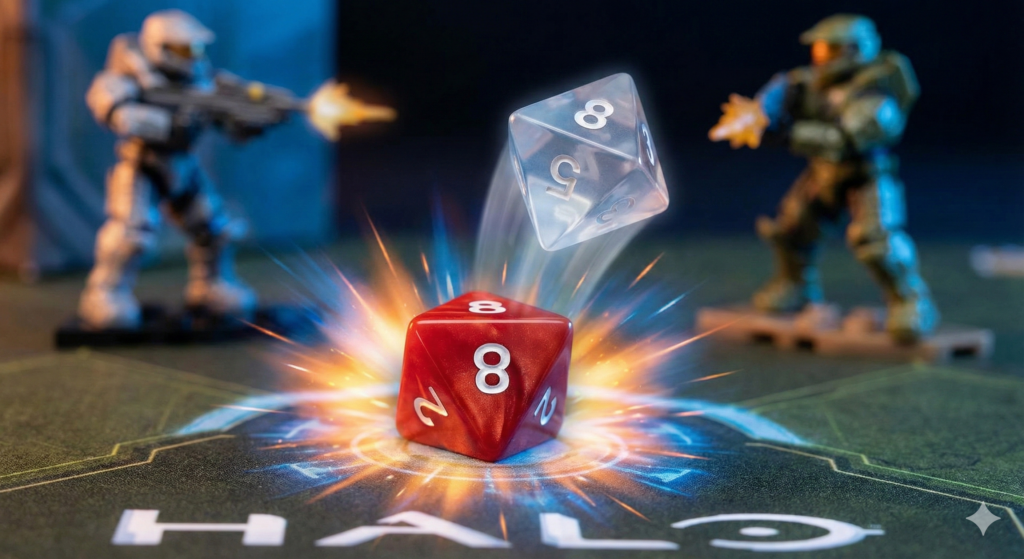
- The exploding 8: This is where magic comes into play. If you roll an 8, this not only counts as a success, but you can also roll an additional dice.
- If you dice a success again on the new roll, this is added to the total result.
- If you roll an 8 again, you can roll a new dice.
- This chain can theoretically go on indefinitely (as long as you dice 8s).
The advantages: Why W8 and explosions?
Why did Mantic opt for this system? It has some decisive design advantages that perfectly match the Halo feeling.
1. the “Master Chief” moment
Halo is known for heroic deeds. A Spartan who fights against a superior force and wins through sheer skill (and luck). The “Exploding 8” simulates exactly that. Even when a shot seems almost impossible, there is always that small statistical chance that a dice will “explode”, triggering a chain of successes and taking an opponent out of the game with a single “shot”. This causes cheers around the table.
2. granularity without complexity
A W6 offers only six results (16.6% probability per side). A W8 offers finer gradations (12.5% per side). This allows designers to adjust unit values (Spartans vs. Marines vs. Elites) in a more nuanced way without complicating the game. A difference between a value of 4+ and 5+ is mathematically noticeable with a W8, but not as drastic as with a W6.
3. dynamism instead of stagnation
In many systems, there are situations in which you can no longer win mathematically (e.g. “I need 4 successes, but only have 3 dice”). The exploding 8 breaks this mathematical ceiling. As long as you have a dice, anything is theoretically possible. This keeps the tension up until the last second.
The disadvantages: Where there is light, there is also shadow
Of course, no system is perfect. The W8 mechanic with exploding dice also has its critics, especially among tournament players.
1. the “swinginess” (high variance)
The biggest problem is the unpredictability. You can have the best tactics, position your units perfectly – and then your opponent rolls two 8s in a row and wipes out your key unit, even though statistically he should have lost. For strategists who like to calculate everything, this “gambling element” can be frustrating.
2. the feeling of unfairness
If one side has a streak of exploding 8s (“hot dice”), the game can quickly feel “broken” for the opponent. Since the 8s often trigger critical effects or ignore armor, a single lucky roll can tip the balance of the game more than in systems with a flatter probability curve.
3. time required (minimum)
Although the system is fast, re-rolling the dice can briefly interrupt the flow of the game in the event of extremely lucky streaks (“Wait, I get to roll another one… and another one…”). However, this is usually more a moment of tension than a real delay.
Probabilities
For Halo: Flashpoint, it is important to understand that the “exploding 8” does not statistically change the probability of a simple success (at least one) with target values of 8 or lower. However, it drastically increases the chance of critical effects (multiple successes) and average damage.
Since you usually roll a pool of 3 dice (3W8) in the game, I have also calculated this probability, as this reflects the more realistic situation at the gaming table.
The probability matrix (W8)
| Stat value (target) | Chance per dice (1W8) | Chance with standard pool (3W8)* | Difficulty |
| 2+ | 87,5 % | > 99 % | Trivial |
| 3+ | 75,0 % | 98,4 % | Very light |
| 4+ | 62,5 % | 94,7 % | Light |
| 5+ | 50,0 % | 87,5 % | Average (Marine/Grunt) |
| 6+ | 37,5 % | 75,6 % | Challenging (Spartan) |
| 7+ | 25,0 % | 57,8 % | Heavy |
| 8+ | 12,5 % | 33,0 % | Heroic (Only on the 8) |
*The “Chance with standard pool” column shows the probability of achieving at least one success with 3 dice.
Analysis for your game
Here are three key takeaways from this table that you can use for your article or your next game:
- The “Spartan hurdle” (4+): Many elite units and Spartans often have values of around 4+. Mathematically, this means that with a single dice you fail more often than you hit (only 62.5%). But with the pool of 3 dice, your chance of success jumps to a solid 94.7% for at least one hit. This shows why covers are so important – they manipulate this curve.
- The power of 8: If you have a target value of 6+ (e.g. due to negative modifiers or cover), your chance with a single dice drops drastically to 37.5%. Even with 3 dice, you only hit with 75% (min. one hit)). The “exploding 8” is your only salvation here.
- Explosion = damage: It is important that the explosion increases the expected value of the successes.
- With a roll on the 5+ you normally have a 50% chance of success.
- Due to the exploding 8 (which happens on average about every 8 rolls and generates further successes), the actual mathematical value of a dice with a target of 5+ is not 0.5 successes, but rather 0.57 successes. So in the long run, you do more damage than the pure percentage suggests.
Death zone: Why “No cover” means your end
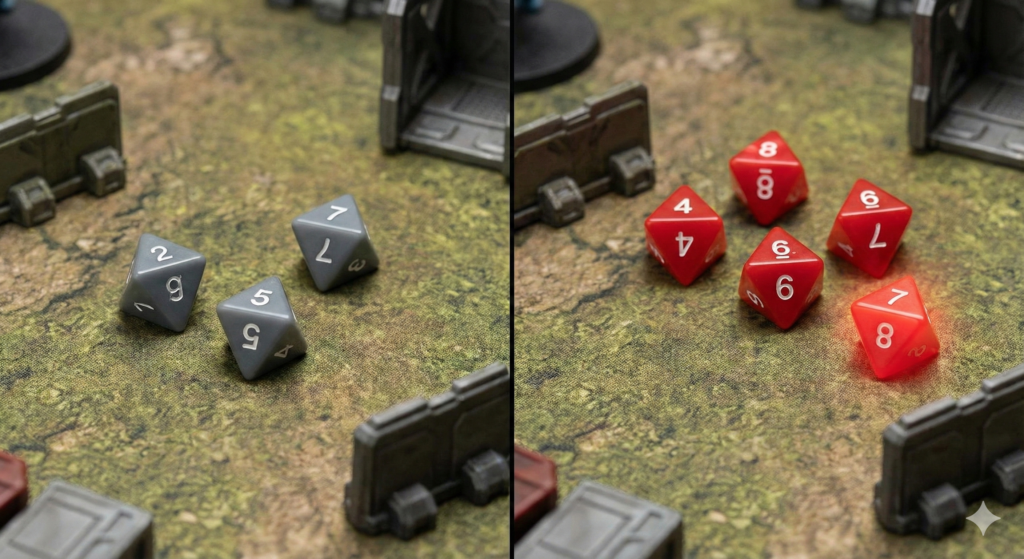
Many beginners make the mistake of thinking: “Oh, the two extra dice won’t make a big difference.” Mathematically speaking, this is a fatal error. If you stand in the open without cover and are shot at, you allow your opponent to roll 5 dice (5W8) instead of the usual 3 (modifier for Clear Shot).
Let’s take a standard dice roll: The opponent needs a 4+ to hit (a hit probability of 62.5% per dice).
The analysis: mass instead of class
With 3 dice, the result is usually moderate – one or two hits. With 5 dice, however, the probability curve shifts drastically upwards. Suddenly, 3 or 4 hits are no longer a matter of luck, but a statistical average.
This means that without cover you are not only “more likely” to be hit, you will be destroyed because the number of successes breaks through your Spartan’s armor much more easily.
Table: The probability distribution (target 4+)
This table shows the probability of achieving exactly a certain number of successes.
| Number of successes (hits) | With cover (3 dice) | Without cover (5 dice) | Analysis |
| 0 hits (completely off the mark) | 5,3 % | 0,7 % | Without cover, it is almost impossible to miss. |
| Exactly 1 hit | 26,4 % | 6,2 % | A common result with cover. |
| Exactly 2 hits | 43,9 % | 20,6 % | With coverage of the average. Survivable. |
| Exactly 3 hits | 24,4 % | 34,3 % | The turning point. The most common result without cover! |
| Exactly 4 hits | 0 % (Impossible*) | 28,6 % | Deadly range. Almost 30% probability. |
| Exactly 5 hits | 0 % (Impossible*) | 9,5 % | The safe overkill. |
*Note: Calculated without “Exploding 8s”. With explosions, of course, more hits are possible even with 3 dice, but the base probability is decisive here.
What these figures mean
Look at the line for 3 or more hits:
- With cover (3W8): The chance that your opponent will roll 3 successes is only around 24%. You are therefore relatively safe.
- Without cover (5W8): The combined chance that the opponent will achieve 3, 4 or even 5 successes is an incredible 72.4%.
The bottom line: Ignoring cover almost triples the chance that you will be hit by a massive volley (3+ hits). In addition, if you roll 5 dice, you have an almost 50% higher chance of rolling an “Exploding 8”, which leads to even more absurd damage values. Since the Spartans only have two shields in the rules, the shift from 2 to 3 hits is massive.
Stay low, Spartan. Otherwise the math is against you.
Boom! The headshot danger (critical hits)
The real horror of being caught without cover is not just the number of hits, but the drastically increased chance of an “Exploding 8”.
The 8 is the “headshot”. It allows the opponent to continue rolling and form damage chains that can wipe out even the strongest Spartan with one attack.
How much does the risk increase with the two additional dice?
Table: The probability of critical hits (The 8)
| Scenario | Chance of at least ONE 8 (Crit) | Chance of at least TWO 8s (double crit) | Analysis |
| With cover (3 W8) | 33,0 % | 4,1 % | Every 3rd attack triggers an explosion on average. That is risky, but calculable. |
| Without cover (5 W8) | 48,7 % | 11,2 % | Almost every 2nd attack explodes! The chance of a “double crit” almost triples. |
The “coin toss” trap
The figures paint a frightening picture:
- If you use cover, your opponent has to hope for luck (33%).
- If you don’t have cover, you’re basically gifting him a coin flip (almost 50%) to explode his dice.
Even worse is the column “Two 8s”:
- With 5 dice, the opponent has a realistic chance of over 11% of being allowed to re-roll two dice immediately. This is the moment when a single attack causes 4, 5 or 6 points of damage and immediately decides the game.
Conclusion: Cover not only reduces the probability of being hit – it is your most important insurance against the deadly “Exploding 8”.
Conclusion: Does it go with Halo?
Opting for W8 and exploding dice is a win for Halo: Flashpoint. Halo is a fast, deadly game. Shields charge, shields break, and a well-aimed hit can mean the end.
The “Exploding 8” captures this arcade feeling perfectly. It rewards aggression and ensures that no Spartan can ever feel too safe on the pitch – no matter how thick their armor is.
It may not be the driest, fairest tournament system in the world, but it is cinematic. And that’s exactly what we want when we move our Spartans around the pitch.