
Master Unit List
Using the Master Unit List (MUL) for BattleTech Alpha Strike: An expert guide to canonical list building
This article serves as a comprehensive guide to using BattleTech’s official Master Unit List (MUL). It is designed to provide advanced list builders and dedicated commanders with concise and technical guidance on unit search, era validation and force creation in the context of BattleTech Alpha Strike. The Master Unit List is the primary and authoritative online database for all BattleTech units.
1 Introduction: The Master Unit List as a canonical data source
The Master Unit List (MUL) was developed to help players sort and filter the thousands of existing combat units (BattleMechs, Vehicles, ProtoMechs, Battle Armor and Aerospace Fighters) in the BattleTech universe. It is the central online tool that provides the unit data for force-building applications for both the Total Warfare (BV system) and Alpha Strike (PV system) rule systems.
1.1. The canonical role of the MUL for Alpha Strike
For Alpha Strike, the MUL is not only a source of unit data, but primarily a tool for validating force composition. It ensures that the units selected by the player reflect the official canon and rules in terms of their Point Value (PV) costs, their tactical capabilities and especially their availability in a chosen historical era and for a specific faction.
The strict adherence to the data stored in the MUL makes the database a central governance tool within the community. Because the data is authorized by the licensors, most organized play groups and tournament organizers accept the statistics presented here as the ultimate authority for a unit’s Alpha Strike Point Values and historical fielding conditions. This ensures that list building goes beyond creative decisions and prioritizes the process of canonical conformity.
1.2. Navigation structure of the MUL
The navigation of the MUL is logically divided into thematic sections that allow the user to search for specific information or go directly to the list builder :
- Units: The central search function for identifying and filtering specific units.
- Eras & Factions: Comprehensive databases for an overview of available timeframes and political actors.
Tools: Includes the critical Alpha Strike Builder and the Total Warfare Builder.

2. Fundamental alpha strike statistics and the unit list search
The Unit List Search function, which is accessed by clicking on the Units tab, offers a variety of filters ranging from basic queries to highly specialized Alpha Strike parameters.
2.1. Basic and advanced search fields
The Basic Search Fields can be used for quick identification:
- Name or Model: Direct search for the specific variant model (e.g. Warhammer WHM-6R) or the generic unit name.
Tons: Filter by tonnage range to isolate units of the desired weight class.
Role: You can filter by tactical role (e.g. sniper, skirmisher, hunter) to form the force based on the desired battle strategy.
The ADVANCED SEARCH FIELDS contain the essential filters for ensuring Lore conformity, in particular the era and fraction filters, which are discussed in detail in Section 3.
2.2. Alpha Strike-specific search parameters
Specific search options are available to optimize list building for Alpha Strike :
- PV (Point Value): The point value system rates the combat power and survivability of an Alpha Strike unit. Players can enter a PV range to ensure that the selected units are within the agreed force limits.
AS Abilities: This filter allows you to enter codes for special Alpha Strike abilities (AS Abilities) such as ECM (Electronic Countermeasures), PRB (Active Probe) or OMNI (Carrying Capacity for Battle Armor). This is crucial for finding units with certain tactical advantages, such as scouts or electronic warfare units.
2.3. Detailed analysis of the tactical stat values
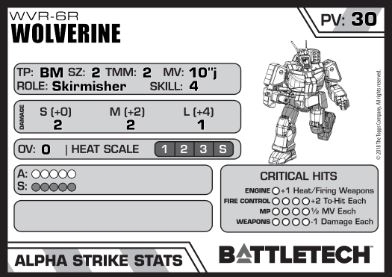
The values displayed in the Alpha Strike Force Builder (ASFB) represent the condensed anatomy of the Alpha Strike Unit Card. A deep understanding of these values is essential for tactical optimization.
2.3.1. Point Value (PV) and pilot ability (skill)
The PV value is the currency of the Alpha Strike game. It is directly correlated to the pilot’s skill, which is set to level 4 by default.
Reducing the skill level (e.g. from 4 to 3) improves the hit probability, but is associated with a significant increase in the cost of the PV value. The cost of a skill upgrade in Alpha Strike is typically between 20% and 25% of the unit’s base PV. This investment must be carefully considered. The statistically greatest increase in damage output from a skill upgrade occurs when the required target number is reduced from 8 to 7, which is usually the case at medium range against highly mobile targets (Target Movement Modifier, TMM, of 2 or higher). In such situations, the effective damage output can increase by up to 40%, as the hit probability rises from around 42% to 58%.
Conversely, investing in skill upgrades is less profitable if the unit mainly fights at short range (target numbers 5 or 6), as the absolute increase in hit probability is then proportionally lower. The decision to upgrade a pilot should therefore be based not only on the total score, but on the
2.3.2. Damage profiles and overheating (OV)
Firepower is quantified by the damage values S, M, L and the overheating value (OV), all of which are listed in the ASFB (Alph Strike Force Building):
- S, M, L (Short, Medium, Long): These values represent the heat-neutral damage – the damage that the unit can inflict in the respective range category without suffering overheating penalties. In the event of a successful hit, the entire specified damage is applied (all-or-nothing principle).
OV (Overheat Value): This value indicates the additional damage the unit can cause in a turn by taking overheat. Awareness of the OV value is crucial, as it indicates the ability to inflict short-term damage peaks (burst damage).
A high OV value (e.g. 2 or 3) means that the unit is capable of inflicting massive damage, but will subsequently suffer heat penalties that may result in movement restrictions or modifiers for subsequent actions. The strategic list builder must plan for these units as aggressive attackers that must be deployed quickly and decisively to eliminate the enemy before the cumulative heat renders the unit itself useless.
3. Unit search and Lore conformity: era and faction validation
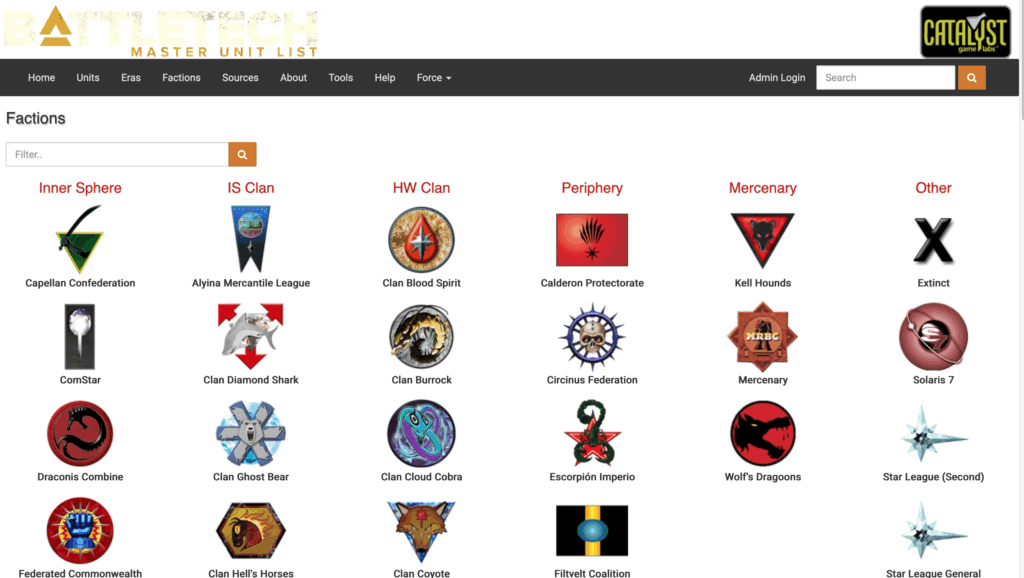
Historical accuracy is a cornerstone of the BattleTech game. The MUL provides the tools under the Advanced Search Fields to ensure that a force is valid in a specific historical context (era) and under a specific political entity (faction).
3.1. The BattleTech timeline and era filter
The BattleTech universe is divided into six main eras that depict the technological progress, decay and rebirth of political powers.
3.1.1. Distinction between production and availability era
The MUL offers two essential era filters, the correct use of which is critical for tournaments and themed games :
- Production Era: Indicates the year or period in which a unit was first introduced.
- Availability Era: Indicates the era(s) in which the unit was actually in military use.
The decisive filter for compliance with the Lore and the rules of the game is the Availability Era. It is insufficient to check only the production era. For example, a high-tech BattleMech may have been produced in the Star League (2571-2780), but during the Succession Wars (2781-3049) may no longer have been militarily usable or available due to technological decay (LosTech). The availability era thus reflects the actual operational capability and not just the original production.
3.1.2. Main eras for filter setting
The main eras available as filters on the MUL include :
- Star League (2005-2780): The age of advanced technology.
- Succession Wars (2781-3049): Characterized by the massive loss of technology.
- Clan Invasion (3050-3061): Beginning of the encounter with the technologically superior clans.
- Civil War (3062-3067): Internal conflicts after the clan defense.
- Jihad (3068-3080): The war against the Word of Blake.
- Dark Age (3081-3150): The era after the founding of the Republic of the Sphere.
- IlClan 3151 – 9999: The era of the IlClans
3.2. Fraction filtering and technology base
Faction filtering allows players to limit their search to units that were canonically used by a specific political entity.
The MUL lists all important players, including the Great Houses of the Inner Sphere (e.g. Capellan Confederation, Draconis Combine, Federated Suns, Free Worlds League) and the various clans. Selecting a faction in combination with an era (e.g. Draconis Combine in the Clan Invasion period) ensures a faction-based force.
In addition, the filter technology must be observed :
- Inner Sphere (IS): Units designed and used by the Great Houses and independent forces of the Inner Sphere.
- Clan: Units designed by the descendants of the Star League Defense Force (SLDF).
- Mixed: Units that use a mixture of IS and Clan technologies.
- Primitives: Early units.
The simultaneous use of these filters prevents clan units from being accidentally included in a pure Inner Sphere force, for example.
4. Detailed functionality of the Alpha Strike Force Builder (ASFB)
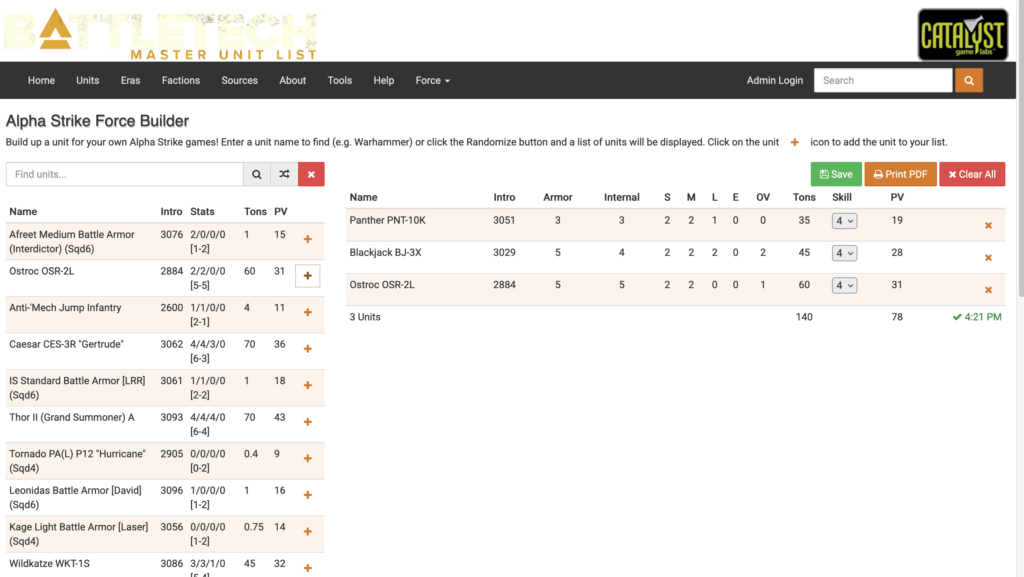
The Alpha Strike Force Builder (ASFB), accessible via the Force tab , is the dedicated tool for assembling and documenting a rule-abiding Alpha Strike force.
4.1. List structure and unit selection
A list is created in the ASFB in three steps :
- Identify unit: The user enters the name or model of the desired unit in the search field (e.g. Warhammer) or uses the randomize function.
Statistics check: The search results show the basic statistics (Name, Intro, Tons, PV), which enables a quick preliminary check of the costs and the model.
Add to the list: Clicking on the unit icon next to the search result will add the unit to the active force list.
The builder continuously keeps the total values of the force (number of units, total tonnage, total PV) up to date, which makes it easier to comply with the agreed PV limit.
4.2. The force display and its characteristics
The final list in the ASFB provides a comprehensive overview of all critical Alpha Strike values of the selected units.
Table: Characteristics in the Alpha Strike Force Builder (ASFB)
| Column designation | Function | Tactical importance |
| Name / Intro | Model name / year of introduction | Identification and verification of Lore conformity. |
| Armor / Internal | Armor points / Inner structure points | Indicates the total toughness of the unit (armor must be penetrated first). |
| S, M, L | Damage at short, medium and long range | Primary damage output and role determination (e.g. Brawler vs. Sniper). |
| E | Damage at extreme range | Niche for certain long-range weapons. |
| OV | Overheat Value (overheating) | Additional, risky damage multiplier (burst damage). |
| Tons | Tonnage | Relevance for scenario or weight class restrictions. |
| Skill | Pilot skill level | Direct influence on the hit probability. |
| PV | Point Value | The final cost of the unit in this configuration. |
4.3. Configuration of the pilot capability and strategic consequences
Although the ASFB displays the skill level, the player usually has to apply external rules or manual processes to adjust the PV value of a unit from skill 4 (default) to higher (e.g. skill 3) or lower (e.g. skill 5 or 6) levels. The PV values shown are often based on the default skill level.
Changing the pilot ability is a purely strategic decision that affects the overall efficiency of the force. An analyst building a force must weigh the PV cost increase (from 20% to 25% per level, depending on the PV bracket ) against the marginal gain in hit probability, especially if the force is operating under tight PV limits. This careful balancing of cost and reliability is the key to PV optimization.
5. Advanced list building concepts and export management
The MUL provides the necessary data to comply with the basic rules (PV, stats, era), but the more complex rules of the Alpha Strike formation require additional manual management, especially with regard to faction affiliation and unit limits.
5.1. Roll-based list building and PV limits
Professional list building starts with setting the PV limit, as this determines the size of the force (e.g. 200 PV for small games, 350 PV for tournaments). The force should then be structured according to tactical roles to maximize synergies :
- Frontliner/Tank: Units with high Armor/Internal, often with good mid-range damage.
- Sniper: Units with high L or E damage that can support from a distance.
- Skirmisher/Light: Highly mobile units with high TMM that carry out flanking attacks or reconnaissance.
5.2. Dealing with rare units
Some units are canonically rare, even within a faction for which they are listed as available. These so-called rare units are limited to one unit per company. The player must monitor this limit manually. The limitation of rare units presents an additional hurdle for list building, which emphasizes the need to consult the more in-depth Alpha Strike Commander’s Edition rules in addition to the MUL database.
5.3. Export functions and documentation
The final function of the ASFB is the documentation of the force. The builder offers the options Save, Clear All and Print PDF.
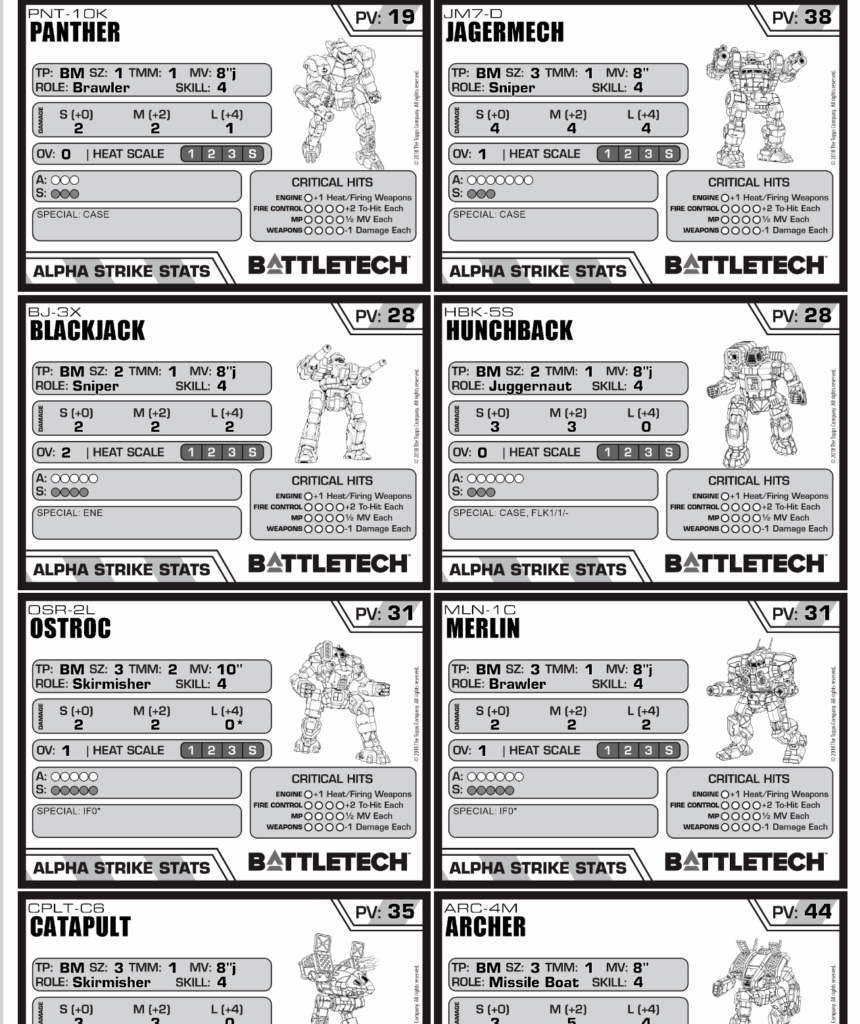
The Print PDF function generates the official force document that summarizes all relevant Alpha Strike stats (Armor, Internal, S/M/L/E, OV, Skill, PV) in a standardized format. After generation, the download PDF link is provided to the user.
The creation of this PDF file is essential for two reasons:
- Readiness to play: This serves as a direct reference point during the game.
- Auditability: It provides the necessary documentation to prove compliance with PV limits, era and faction rules to opponents or tournament organizers.
6. Conclusion
The Master Unit List (MUL) is the essential tool for any dedicated Alpha Strike player. Its function goes far beyond simply providing game statistics; it acts as a centralized management tool that ensures the canonical integrity of the force.
The ability to filter units precisely by era of availability and faction is key to creating historically accurate forces. Only by using these advanced search fields can the list builder ensure that the selected BattleMech variants were realistically deployable in the selected time frame and for the selected political entity.
The Alpha Strike Force Builder is a powerful calculator and export manager. It provides all relevant tactical data (PV, damage profiles S/M/L/E, OV) and enables data-driven optimization of pilot skills. However, compliance with advanced list building rules requires manual logging and monitoring by the player to limit rare units, as the ASFB does not automatically manage these complex canonical restrictions. The final PDF documentation from the ASFB serves as a mandatory audit document for any tournament participation or thematic game.
Transparency notice on the use of AI (in accordance with the EU AI Act):
The content of this blog is personally conceived, researched and defined by me. I use generative artificial intelligence to help me formulate and structure the texts.
Why? This enables me to prepare complex issues more precisely and to focus fully on the quality of the content and research. The final editorial control and responsibility for all published content lies solely with me.
Together for better content!
This blog is a project of the heart that can only continue to grow with your help. Every comment, every recommendation – and especially your financial support – secures the future of this platform.
Do you want this content to remain freely accessible?
This is how you can support the mission:
- NEWSLETTER REGISTRATION: Become part of the fast-growing community and never miss an update again!
- BECOME A PATREON MEMBER: Join the inner circle and get access to exclusive material and early releases.
- OTHER SUPPORT: Whether it’s a donation, sharing a post or recommending the blog to others – every form of support counts!
Let’s make this blog an even better place together!

