
Halo: Flashpoint – The ultimate strategic almanac and market report for German-speaking countries
1. Introduction: The renaissance of Spartan warfare on the tabletop
- Halo: Flashpoint – The ultimate strategic almanac and market report for German-speaking countries
- 1. Introduction: The renaissance of Spartan warfare on the tabletop
- 2. Market analysis: availability, editions and localization in the DACH region
- 3. The game engine: Anatomy of a battle
- 4. Faction analysis: UNSC Spartans – The spearhead of humanity
- 5. Faction analysis: The Banished – brutality and asymmetry
- 6. Game modes and scenario tactics
- 7 The battlefield: terrain and atmosphere
- 8. Hobby section: Painting and aesthetics
- 9 Organized Play & Community in Germany: Roadmap 2025
- 10 Conclusion and strategic recommendation
- Gemeinsam für besseren Content!
1.1 Historical context and the legacy of Halo in miniatures wargaming
The story of Halo in tabletop wargaming is a tale of ambition, loss and now, in 2024 and 2025, a triumphant resurrection. To fully grasp the significance of
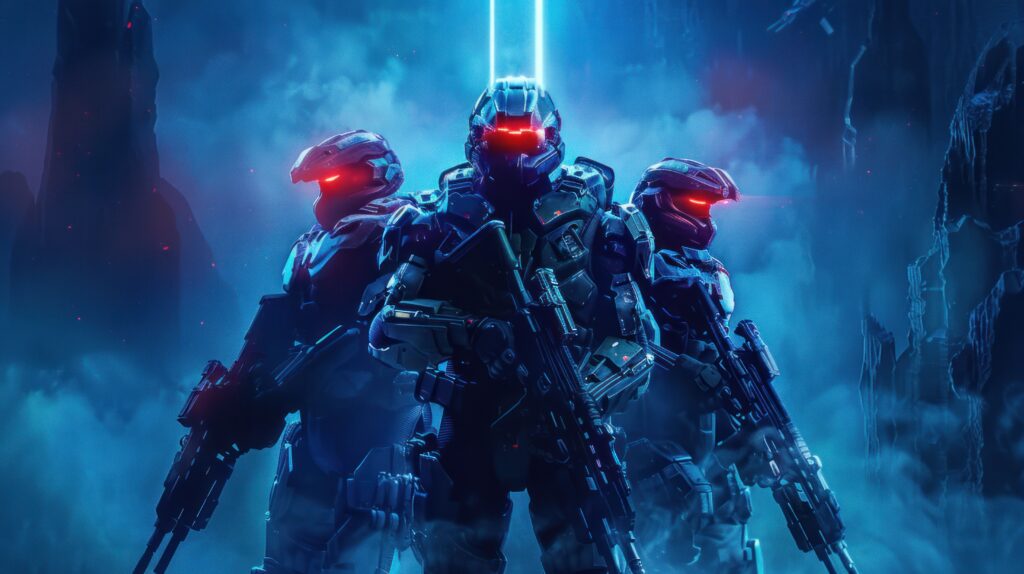
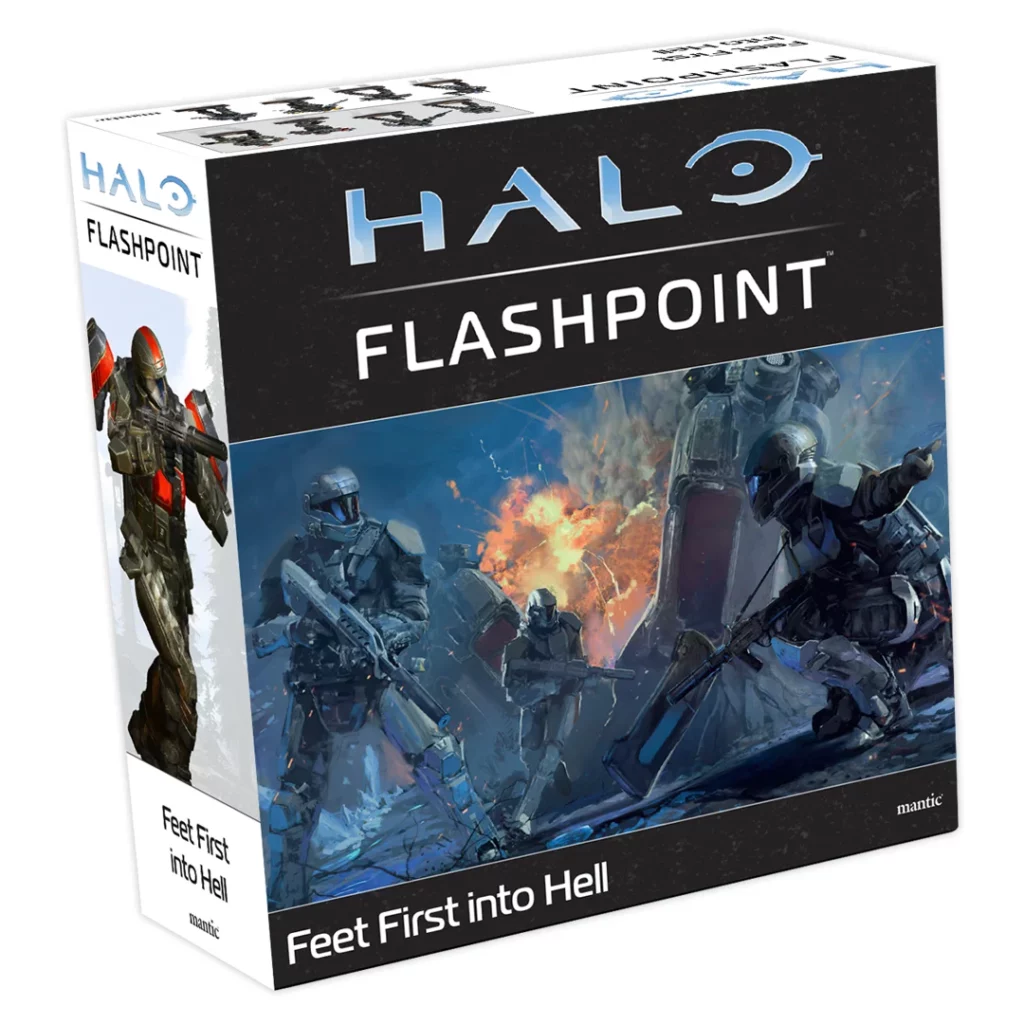
The announcement that Mantic Games – a British studio that has built a reputation for robust, tournament-ready rules systems with Kings of War and Deadzone – would take over the license in cooperation with 343 Industries (now Halo Studios) marked a paradigm shift. Unlike its mass battle-oriented predecessors, Halo: Flashpoint deliberately positions itself as a tactical skirmish game. This design decision reflects a broader trend in the tabletop market, which is moving away from hour-long set-ups towards faster, more dynamic battles in smaller spaces (“kitchen table gaming”). This is a significant development for the German market, which traditionally has a high affinity for tactical depth and high-quality components.
1.2 The design philosophy: Why Flashpoint is not a “Deadzone clone”
Critics and analysts were quick to point out the similarities to Mantic’s Deadzone engine. However, a detailed analysis of the game mechanics shows that it is not a simple “reskinning”, but a profound evolution. While Deadzone is set in a dark, post-apocalyptic setting, Flashpoint had to emulate the specific gunplay and physics of the Halo video games.
The result is a system that adopts the fundamental cube system, but creates a completely new dynamic through mechanisms such as regenerating energy shields, respawn logic and weapon pickups. In classic wargames such as Kill Team or Infinity, the loss of a unit is often permanent and punishing, leading to cautious, defensive play. Flashpoint, on the other hand, uses respawn mechanics to encourage aggressive maneuvers and heroic “suicide runs” to secure mission objectives – a design philosophy borrowed directly from the multiplayer modes Slayer and Oddball. This shift from resource conservation (unit survival) to resource deployment (sacrificing units for points) is at the core of what sets Flashpoint apart from the competition and makes it accessible to video gamers without boring veterans.
2. Market analysis: availability, editions and localization in the DACH region
2.1 The release schedule and logistical challenges in Germany
Although the official global launch took place in November 2024, the picture of availability in German-speaking countries is different. Mantic Games operates from the UK, which has created logistical hurdles for imports into the EU since Brexit. While English-language versions were often available promptly from wholesalers, German fans sometimes had to wait for localized goods or go to specific retailers.
The situation in 2025 shows that the “First Wave” is largely established, but bottlenecks can occur with specific expansions such as the Banished accessories. Retailers such as Kutami, Taschengelddieb and FantasyWelt have established themselves as the primary points of contact for German versions. One critical aspect for German consumers is the distinction between the “DE” version and the “EN” version in online retail. As many stores list both versions, you need to pay close attention when buying, especially if you value German unit cards and rulebooks.
2.2 Edition analysis: Recon vs. Spartan – An economic evaluation
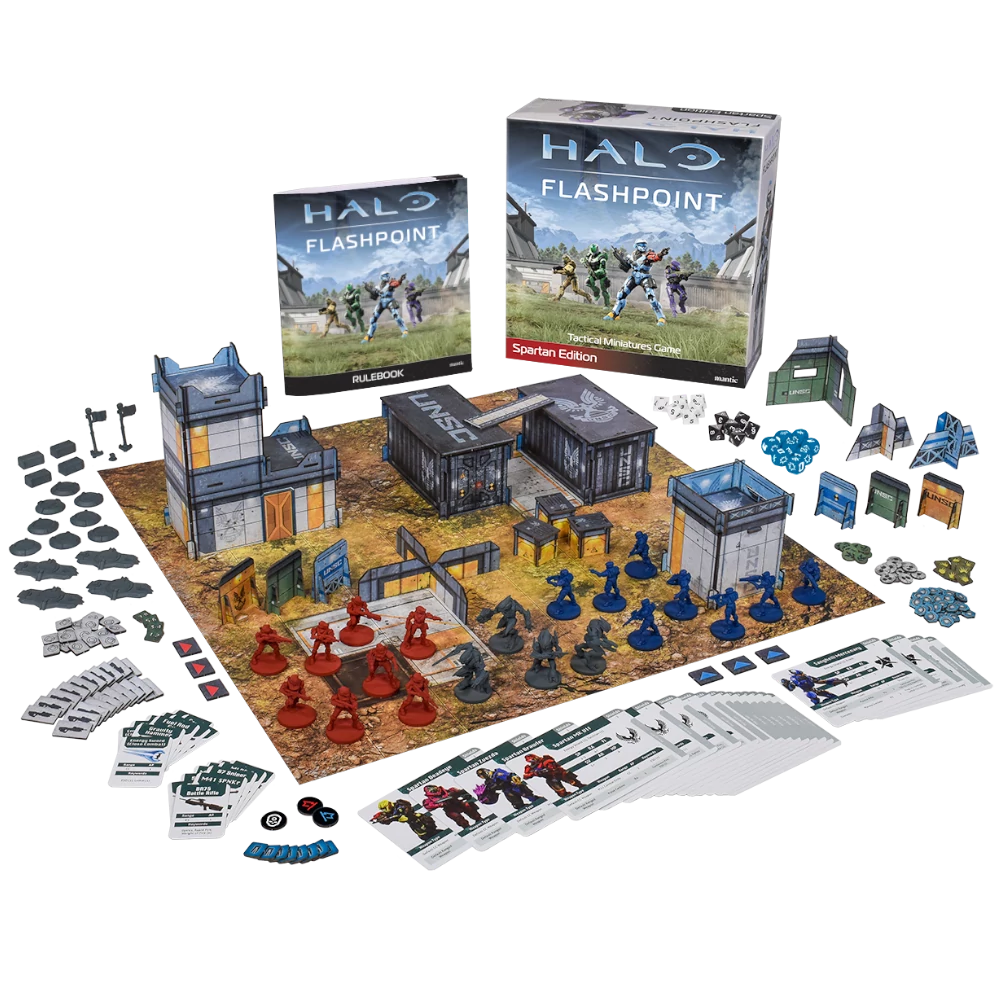
For newcomers, the question of the right investment inevitably arises. Mantic offers two main entry points: the
Table 1: Comparative analysis of the starter sets for the German market
| Feature | Recon Edition (beginner) | Spartan Edition (experts/collectors) | Strategic evaluation |
| List price (RRP) | approx. 60,00 € – 75,00 € | approx. 100,00 € – 125,00 € | The surcharge for the Spartan Edition is approx. 60-70%, but the content value increases by over 150%. |
| Spartan models | 8 models (4 red, 4 blue) | 16 models (8 red, 8 blue) | The Spartan Edition offers full tactical flexibility for mirror matches and team building. |
| Elite/Banished models | None (0) | 4 Sangheili Mercenaries | Only the Spartan Edition allows “out of the box” asymmetrical battles (Covenant vs. UNSC). |
| Playing field | Double-sided paper mat | Hardcover game board (cardboard) + paper mat | The fixed game plan is essential for the stability of the 3D terrain and its longevity. |
| Terrain | Standard cardboard terrain | Expanded cardboard terrain + 3D arena accessories | Spartan contains plastic connectors and accessories that massively enhance the feel. |
| Additional material | Standard token/dice | Extended tokens, more dice, cover tokens | More command dice in the Spartan Edition make the game flow much easier. |
Strategic buy recommendation:
For the German market leader and serious hobbyists, the Spartan Edition is virtually without alternative. The lack of enemy faction models (Elites) in the Recon Edition reduces the gaming experience to pure training simulations (Spartan against Spartan). While this is “Lore-accurate” for the UNSC’s War Games simulations, it lacks the tactical asymmetry that defines Halo. If you buy the Recon Edition, you will inevitably have to buy expansions such as the Banished Pack or Fireteam Hydra later on, which pushes the total cost above the price of the Spartan Edition. The Recon Edition is primarily suitable as a second purchase to expand your stock of Spartans and dice at a reasonable price, or for casual players with a strict budget limit.
2.3 Localization: quality and language barrier
A frequently discussed topic in the German community is the quality of the translation. Mantic Games provides German rulebooks and maps. The print versions are included in the German boxes, while digital PDFs are often delayed and only appear in English.
One important aspect is the vocabulary: Terms such as Headshot, Slayer, Oddball or Capture the Flag are often left in the original English or only translated in a bumpy way. However, this is not a disadvantage, but a necessity, as the international tournament scene and communication on platforms such as Discord use English terminology almost exclusively. German players should therefore not be afraid to learn the English terms in parallel in order to be able to clarify rules issues in international forums. There has been criticism of the availability of the German rules as a separate purchase product; often buying a starter set is the only way to get the physical German rulebook, as separate print runs are rare.
3. The game engine: Anatomy of a battle
At the heart of Halo: Flashpoint is a rules system that seeks to combine speed and tactical depth. It breaks with many of the conventions of classic wargames.
3.1 The Cube System: Abstraction as a tactical tool
Instead of using measuring tapes and folding rules, which often leads to discussions about millimeters and inaccurate movements (“Wobbly Model Syndrome”), Flashpoint uses a strict grid of 3×3 inch (approx. 7.5 cm) dice.
- Movement mechanics: The playing field is an 8×8 grid (standard size). A movement of “2” means that a model can move into two adjacent cubes. Diagonal movements are allowed, but may be blocked by terrain.
- Positioning within the cube: This is the most subtle and important tactical aspect. Although a model is assigned to a cube (defined by the center of the base), the physical position within the cube is critical to the Line of Sight (LOS). A player can place their model on the far edge of a cube to peer around a corner while still being protected by the cube. This eliminates measurement errors, but retains the tactical finesse of “cutting corners”.
- Crew limits (stacking limits): A cube can hold a maximum of two models (or four if it is two hostile fireteams engaged in close combat). This prevents the dreaded “deathballs” in wargaming – the gathering of all units at one point in order to maximize bonuses. Players are forced to fan out their troops and cover flanks, which keeps the board dynamic.
3.2 The mathematics of war: D8 and the “Exploding 8s”
While Warhammer 40,000 traditionally uses six-sided dice (D6), Flashpoint uses eight-sided dice (D8).
- Probability distribution: A D8 offers steps of 12.5% per number, as opposed to 16.6% for the D6. This allows the designers to make finer gradations in the profile values of the units. An Elite hitting 4+ has a 62.5% chance, while a Spartan hitting 3+ has a 75% chance.
- Headshot mechanic (exploding dice): This is the salt in the soup of Flashpoint. If a dice shows a natural 8, this counts as a success
and the dice can be rolled again. This process can theoretically be repeated indefinitely.- Tactical implication: Even an almost defeated Spartan, who only has one dice left to defend or attack, can turn the tide with a lucky streak. This perfectly simulates the “clutch moments” from the video game, in which a single perfect shot (headshot) decides a match.
- Criticism and balance: Competitive players may find this too random (“swingy”), but statistically it evens out over a match and provides emotional highlights.
- Rule interaction: It is important to note that headshots are also triggered on rerolls. Abilities such as Weight of Fire, which grant rerolls, therefore not only drastically increase the hit probability, but also the chance of critical hits.
3.3 Command Dice: Resource management
In addition to the standard actions (move, shoot), each player has a pool of command dice.
- The pool: At the start of each round, both players roll their command dice (base: 2, expandable by units with the keyword Tactician).
- Results and application:
- Dice Logo: Adds +1 dice to a test. This is extremely powerful for securing critical shots or guaranteeing survival.
- Arrow/flash (movement): One free movement (1 cube). Allows enormous mobility boosts.
- Crosshair (shot): A free shot. Massively increases the damage output of a unit.
- Swords (close combat): A free melee. Increases the damage output of a unit.
- Helmet (melee): Activate a second model (not on the first turn of a round). Or use it in the end phase to take the initiative for the next round.
- Special: Faction-specific skills.
- Strategy: Managing these dice separates beginners from pros. Units with Tactician (s) are often the first targets, as they allow the opponent to generate more command dice or even carry unused dice into the next turn (“banking”). The targeted elimination of the opponent’s Tactician is often the key to victory.
3.4 The damage model: shields vs. health
You don’t die immediately in Flashpoint.
- Shields: Almost all units (except Grunts and some Brutes) have shields. Shields regenerate when the unit takes no damage. Damage goes to the shields first.
- Health (HP): As soon as the shields are gone, damage goes to the HP. HP does not regenerate.
- Pinned: Certain weapons or massive fire can “pin” a unit. A pinned unit loses actions or must spend actions to get back up. This is often more deadly than direct damage as it removes tactical flexibility. For Banished units such as Brutes, which often rely on melee combat, pinning is the ultimate counter.
4. Faction analysis: UNSC Spartans – The spearhead of humanity
The Spartans are the poster boys of the game and are included in both starter sets. They are the most flexible faction and the most forgiving of mistakes.
4.1 Unit types and roles
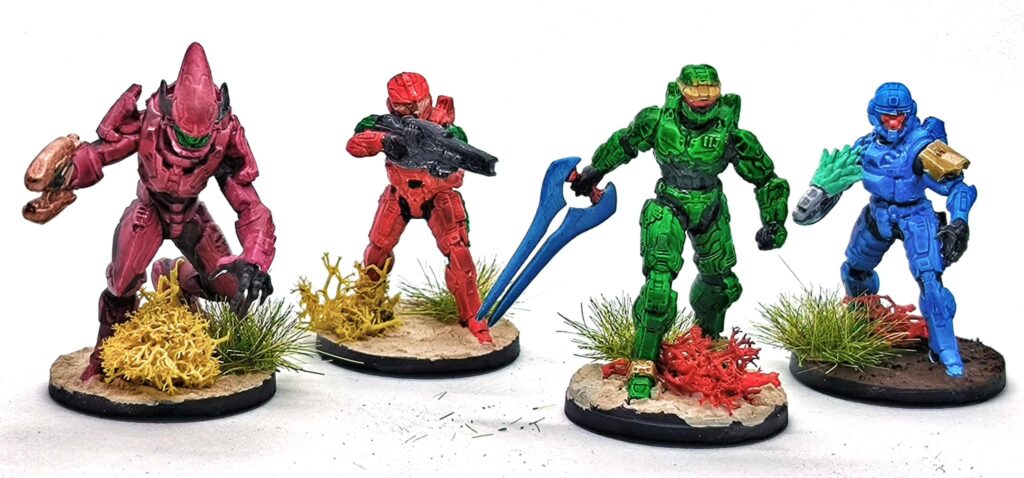
The Spartans are available in different loadouts that define their role on the battlefield.
- Spartan Mk VII (Rifleman): The all-rounder. Equipped with Assault Rifle or Pulse Carbine.
- Role: Medium range, maintain mission objectives. Solid values in all areas.
- Spartan Deadeye (Sniper): Equipped with DMR or Stalker Rifle.
- Role: Long-range support. Thanks to the long range of their weapons, they can control corridors (“lure lanes”). Their headshot probability is often increased by keywords or they ignore cover more easily. In a grid-based game, range is king.7
- Spartan Brawler (Close Quarters): Equipped with Bulldog Shotgun or Needler.
- Role: Zone defense and close combat. The Bulldog is devastating at close range (1-2 cubes). The Needler often has special rules like Supercombine, which deal instant damage on enough hits or ignore armor. Brawlers must be played aggressively to get into range.
- Spartan Zvezda (Heavy): Equipped with heavy weapons such as the Rocket Launcher or Cindershot.
- Role: Armor piercer and area damage. Missile launchers use templates or affect entire cubes (Blast). They are ideal for punishing opponents who group too closely together. Note: Ammunition may be limited (observe reload rules).
4.2 Tactical doctrine: the “Fireteam” concept
A standard Fireteam consists of 4 Spartans. Synergy is crucial.
- Shield rotation: Since shields regenerate, a common tactic is “rotation”. A Spartan intercepts fire, its shields break. In the next activation, it retreats (Disengage/Move), and a fresh Spartan advances into the cube to hold the line. The damaged Spartan regenerates and returns later.
- Grenades: Every Spartan has access to grenades (by picking them up or equipping them). These are essential for driving enemies out of cover(flush out) or for weakening groups of enemies before the heavy weapons fire.
5. Faction analysis: The Banished – brutality and asymmetry
The Banished, introduced by expansions and partially included in the Spartan Edition, bring asymmetry to the game. They play fundamentally differently to Spartans.
5.1 Sangheili (Elites): The arrogant warriors
- Profile: High mobility, very strong shields, but often low health.
- Playstyle: “High Risk, High Reward”. An elite with an energy sword is almost unbeatable in close combat, but has to get there first.
- Weakness: As soon as their shields drop, they are extremely vulnerable (“Squishy”). Unlike Spartans, who often still have armor rolls or moderate HP, Elites fall quickly when focused. The Spartans’ plasma weapons are their natural enemy, as they often have bonuses against shields.
- Elite units: The Sangheili Mercenary (included in the Spartan Edition) often uses Covenant weapons such as the Pulse Carbine, which works well against shields but is difficult to aim.
5.2 Jiralhanae (Brutes): The unstoppable wall
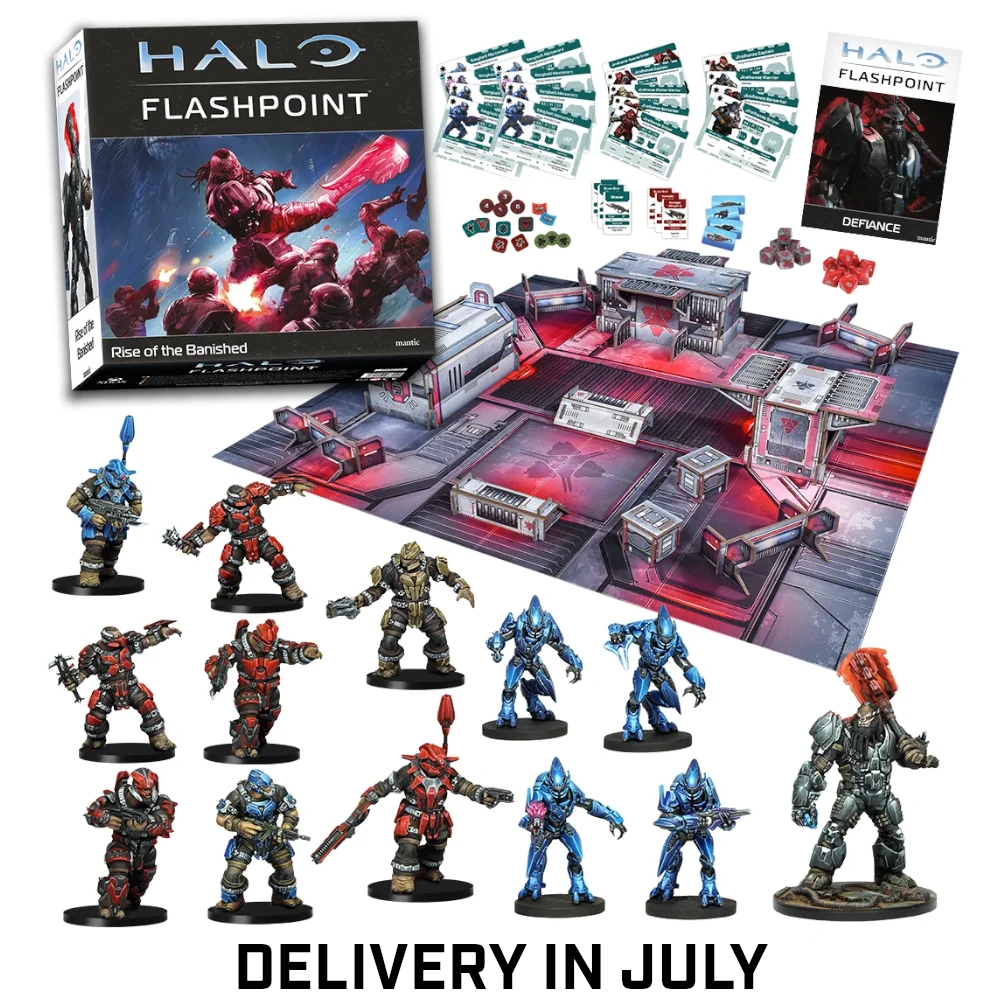
This faction is primarily introduced through the“Rise of the Banished” box.
- Profile: Massive health pools, often no or only weak shields. Slow movement.
- Playing style: “Tank & Smash”. Brutes want to force their opponents into close combat. They often ignore light fire simply due to their mass of health points (Meatshields).
- Keywords:
- Imposing: Gives bonuses in close combat if they outnumber or intimidate the opponent.
- Knockback: Many Brute weapons and melee attacks knock enemies back. This is extremely tactical for knocking Spartans off mission objectives or throwing them off ledges to their deaths (on maps with chasms).
- Rage/Berserk: Some Brutes become stronger when injured.
5.3 Atriox: The warlord
Atriox is a special character model (“Hero”).
- Values: It combines the best of both worlds – strong shields AND massive health.
- Skills: With his weapon Chainbreaker, he can take out Spartans in one hit. His Unstoppable ability allows him to move through enemy control effects. He costs a lot of points (often half of a team), so he needs to be protected until he can strike.24
6. Game modes and scenario tactics
Halo: Flashpoint is not a pure “deathmatch”. The scenarios dictate the tactics. Here is a selection.
6.1 Slayer (Team Deathmatch)
- Goal: Achieve kills.
- Tactics: The “trade” counts here. It’s not worth sacrificing a Spartan unless you’re sure to get a kill back. Focus fire is essential: It’s better to eliminate one enemy completely than to only injure three (as shields regenerate).
6.2 Oddball (ball possession)
- Objective: Hold a skull (ball) to generate points per round.
- Mechanics: The person carrying the ball often cannot shoot or fight (or can only do so to a limited extent).
- Tactic: “Protect the President”. The ball carrier should be the most tanky character (e.g. a Brute or a Spartan with a shield upgrade). The team must form a defensive formation (“Turtle”) around him. Movement is often more important here than kills.
6.3 Capture the Flag (CTF)
- Objective: Steal the enemy flag and bring it to your own base.
- Tactics: Speed is the trump card. Units with high movement or
Tactician dice for movement bonuses are MVP here. Sacrificing units (“suicide run”) to block the flag bearer or clear the way is a valid strategy, as the respawn allows you to get back into the game quickly.
6.4 Strongholds (area control)
- Objective: To keep several zones on the map.
- Tactics: The team must split up (“splitting”). This is where the weaknesses of the Recon Edition (only 4 models) become apparent, as you can’t be everywhere at once. Brutes are excellent in this mode, as they can physically knock opponents out of the scoring zones (cubes) with their knockback ability.25
7 The battlefield: terrain and atmosphere
7.1 Cardboard vs. plastic
The terrain is not just decoration, it is essential for coverage and verticality.
- Cardboard terrain (cardboard): Included in the starter boxes. It is pre-cut and printed. The quality is surprisingly high and stable enough to support models.
- Tip: Use superglue at the joints of the cardboard if you want to keep the terrain permanently assembled to increase its durability.
- Mantic Terrain Crate (plastic): Compatible with the Deadzone system. It offers more details and modularity. Often preferred for tournaments as it is more robust.
7.2 The 3D printing revolution (STL)
Since Flashpoint uses a fixed grid dimension (3 inch / 75mm), it is a paradise for 3D printers.
- Community designs: Extensive libraries already exist on platforms such as MakerWorld, Cults3D or Thingiverse. Search for “Halo Flashpoint Terrain” or “3 inch sci-fi cube”.
- New Alexandria: A fan-favorite design that recreates the Boardwalk map from Halo: Reach.
- Advantage: You can print entire tables that fit perfectly into the grid (“snap-fit”) without spending hundreds of euros on official plastic. This is particularly attractive for the German community, which is strongly represented in the maker sector.
8. Hobby section: Painting and aesthetics
8.1 The “Master Chief” factor
The Master Chief is the face of the game. Mantic offers him separately in the paint set separately.
- The Paint Set: Developed in cooperation with The Army Painter. Contains the Master Chief and 8 colors of the “Warpaints Fanatic” series.
- Color quality: The Fanatic colors are highly pigmented and often cover in one layer. This is ideal for beginners who want quick results (“battle ready”).
8.2 Painting guide: Spartan 117 (Master Chief)
- Primer: Spray primer in “Army Green” or black.
- Base: Apply the typical Halo green to all armor parts.
- Visor: The iconic golden visor. Start with a dark brown, layer gold over it and add a highlight with light silver or yellow.
- Drybrushing: Use a light green or gray to highlight the edges of the armor (“edge accents”).
- Wash: A dark wash (e.g. Strong Tone) in the recesses gives the armor depth and the “grit” of the battlefield.
9 Organized Play & Community in Germany: Roadmap 2025
9.1 The German community landscape
The scene is fragmented, but is growing together.
- Discord: The central hub. In addition to the official Mantic Discord (which has international channels), there are German servers such as MechStrategen or local tabletop clubs that have set up channels for Flashpoint.15
- Retailer support: Shops such as Würfelgarten in Schwäbisch Hall organize local tournaments and demo days. These physical meeting points are vital for growth.
9.2 Roadmap and dreams for the future
What does the future hold?
- ODSTs: The “Orbital Drop Shock Troopers” are confirmed. They will be an army that can land anywhere on the field via “drop pods”.
- Flood: Rumors and teasers point to a PvE mode (player vs. AI) in which players have to defend themselves against waves of Flood – analogous to the “Firefight” mode in video games. Mantic has already proven that they can do this with the AI in Walking Dead.
- Tournaments: Mantic pushes the tournament scene with official “Organized Play Kits” (prizes, medals). German players should search for events in the Mantic Companion App.
10 Conclusion and strategic recommendation
Halo: Flashpoint is far more than a licensed product looking to make a quick buck. It’s a love letter to the tactical gameplay of the Bungie era, cast in a modern, accessible tabletop guise.
For German fans, the verdict is:
- Buy the Spartan Edition if you want to play seriously. The added value is gigantic.
- Accept English, at least for technical terms, to be part of the global community.
- Use 3D printing to cost-effectively raise your battlefields to a spectacular level.
The game doesn’t just fill the void left by Spartan Games – it adds an accessibility that has long been missing from the hobby. Whether you’re a veteran of “Combat Evolved” LAN parties or a tabletop strategist looking for a new challenge, Flashpoint is ready.
Glossary of the most important terms:
- Cube: 3×3 inch playing field grid.
- Headshot: Dice result 8, which explodes (new roll).
- Tactician: Ability to manipulate command dice.
- Pinned: Status that restricts actions (pinned down).
- Respawn: Re-entry after destruction of the model.
Transparency notice on the use of AI (in accordance with the EU AI Act):
The content of this blog is personally conceived, researched and defined by me. I use generative artificial intelligence to help me formulate and structure the texts.
Why? This enables me to prepare complex issues more precisely and to focus fully on the quality of the content and research. The final editorial control and responsibility for all published content lies solely with me.
Together for better content!
This blog is a project of the heart that can only continue to grow with your help. Every comment, every recommendation – and especially your financial support – secures the future of this platform.
Do you want this content to remain freely accessible?
This is how you can support the mission:
- NEWSLETTER REGISTRATION: Become part of the fast-growing community and never miss an update again!
- BECOME A PATREON MEMBER: Join the inner circle and get access to exclusive material and early releases.
- OTHER SUPPORT: Whether it’s a donation, sharing a post or recommending the blog to others – every form of support counts!
Let’s make this blog an even better place together!

