Battlefield Support in Alpha Strike: My tactical guide
In my Alpha Strike games, I love to use the Battlefield Support System. It allows me to use air strikes and artillery without having to deal with complex aerospace rules or extra miniatures on the table. Instead, I buy a stack of cards for Battlefield Support Points (BSP), which often tips the scales.
Here is an overview of the types of support I use and how I use them tactically.
Offensive air support (Aerospace Support)
When I need quick, hard blows, I call in the air force. The attacks are abstracted: I choose a target or a point, roll against a fixed target number (TN), and if it works, it hails damage.
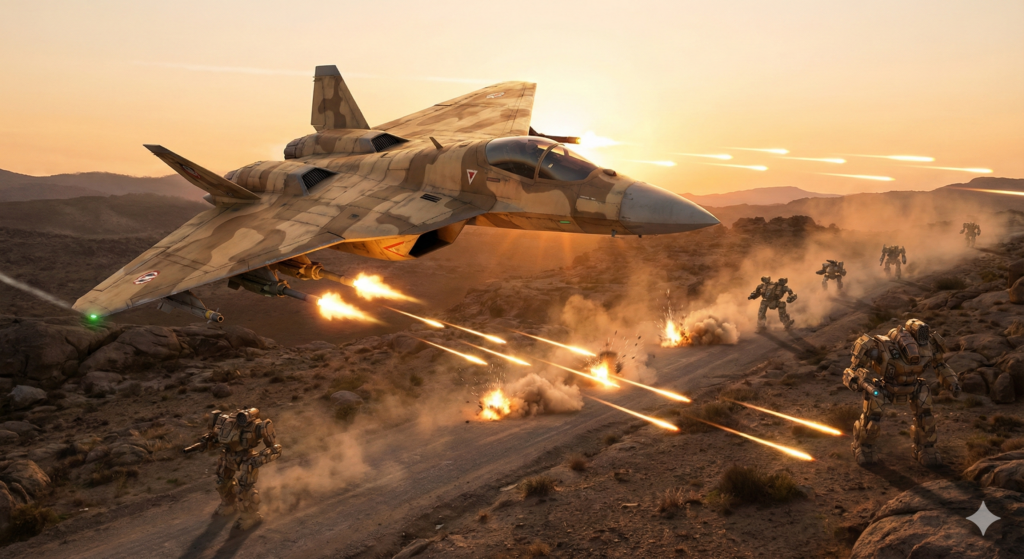
1. light & heavy strike (targeted air strikes)
These are my surgical instruments. They hit exactly one unit.
- Light Strike (2 BSP): Deals 1 damage.
- Heavy Strike (3 BSP): Deals 2 damage.
My tactical assessment: I almost always use the Light Strike as a “finisher”. If an enemy mech only has one structure point left or an annoying hovercraft with high movement (TMM) is hard to hit, the Light Strike is worth its weight in gold. Its target value (TN 5) is often easier to achieve than a regular weapon attack against fast targets. The Heavy Strike is my go-to against medium mechs or to “crack” armored units before my main force opens fire.
2. light & heavy bombing (bombardments)
This is not about precision, but about area. These attacks use templates and hit everything in a radius (area of effect).
- Light Bombing (3 BSP): 1 damage in radius.
- Heavy Bombing (4 BSP): 2 damage in radius.
My tactical assessment: Bombardments are my counter to “pack formation”. If my opponent pulls his units close together (e.g. C3 networks or convoys), I punish this immediately. A Heavy Bombing (TN 7) is harder to hit, but if it hits, it can take out or severely damage a whole lance of light vehicles in one hit.
3. strafing (low-flying attack)
This is the most spectacular attack. The hunter draws a 10-inch line across the playing field and attacks every point along this line (2 inches wide of the line).
- Strafing (5 BSP): 2 damage against everything on the line.
My tactical assessment: I rarely use this because it is very expensive at 5 points and has a high TN (7). But: If the opponent advances in a line on a road or is jammed in a narrow lane, a strafing run is devastating. It is more of a psychological weapon that forces the opponent to break up his formation.
Defensive air support (Air Cover)
Nothing is more frustrating than having your artillery or commander knocked out by a cheap air strike. I use Air Cover against this.
- Light Air Cover (1 BSP): Prevents enemy attacks.
- Heavy Air Cover (2 BSP): Prevents enemy attacks.
My tactical assessment: This is my “insurance”. For just 1 BSP or 2 BSP, I buy myself the chance to completely negate an enemy air attack. I always have at least one of these cards up my sleeve. As soon as the opponent announces a bombing run that threatens my entire flank, I play this card.
Artillery support (Artillery Support)
Artillery reliably covers areas.

1st Thumper
The lightest artillery. My tactical assessment: The Thumper is cheap and great for chasing infantry (Battle Armor). The damage is low, but the psychological effect that no place on the map is safe wears down the enemy.
2. sniper
The mid-caliber. My tactical assessment: My standard pick. It has a good balance of cost and damage. I use it to shoot at slow targets like Assault Mechs that think they’re in cover. A direct hit also hurts an Atlas.
3. long tom
The beast. Huge template, massive damage. My tactical assessment: I only use the Long Tom in big games where I have a lot of points. It’s perfect for cracking “castles” – in other words, when the opponent is statically entrenched. A single good hit can collapse the center of the enemy line. But be careful: it’s expensive and deviates a long way if you roll badly!
I hope this insight helps you in your next battle!
Transparency notice on the use of AI (in accordance with the EU AI Act):
The content of this blog is personally conceived, researched and defined by me. I use generative artificial intelligence to help me formulate and structure the texts.
Why? This enables me to prepare complex issues more precisely and to focus fully on the quality of the content and research. The final editorial control and responsibility for all published content lies solely with me.
Together for better content!
This blog is a project of the heart that can only continue to grow with your help. Every comment, every recommendation – and especially your financial support – secures the future of this platform.
Do you want this content to remain freely accessible?
This is how you can support the mission:
- NEWSLETTER REGISTRATION: Become part of the fast-growing community and never miss an update again!
- BECOME A PATREON MEMBER: Join the inner circle and get access to exclusive material and early releases.
- OTHER SUPPORT: Whether it’s a donation, sharing a post or recommending the blog to others – every form of support counts!
Let’s make this blog an even better place together!