
Alpha Strike game rules
BattleTech Alpha Strike rules: The ultimate guide for quick tabletop battles
Are you looking for an easy-to-understand overview of Alpha Strike rules? Then you’ve come to the right place. While classic BattleTech is known for its enormous depth of detail, Alpha Strike offers the perfect solution for players who want to experience epic battles in less time.
In many blog posts, you will learn how the rules system works and why switching to this fast tabletop format makes sense for your gaming group.
The basis for this is the Alpha Strike Commander`s Edition Version 7
- BattleTech Alpha Strike rules: The ultimate guide for quick tabletop battles
- What makes the BattleTech Alpha Strike rules so special?
- The core mechanics of the Alpha Strike rules (explained in German)
- Blog posts in the category "Alpha Strike rules"
- Comparison: Classic vs. Alpha Strike
- Conclusion: Fast action in the 31st century
- Gemeinsam für besseren Content!
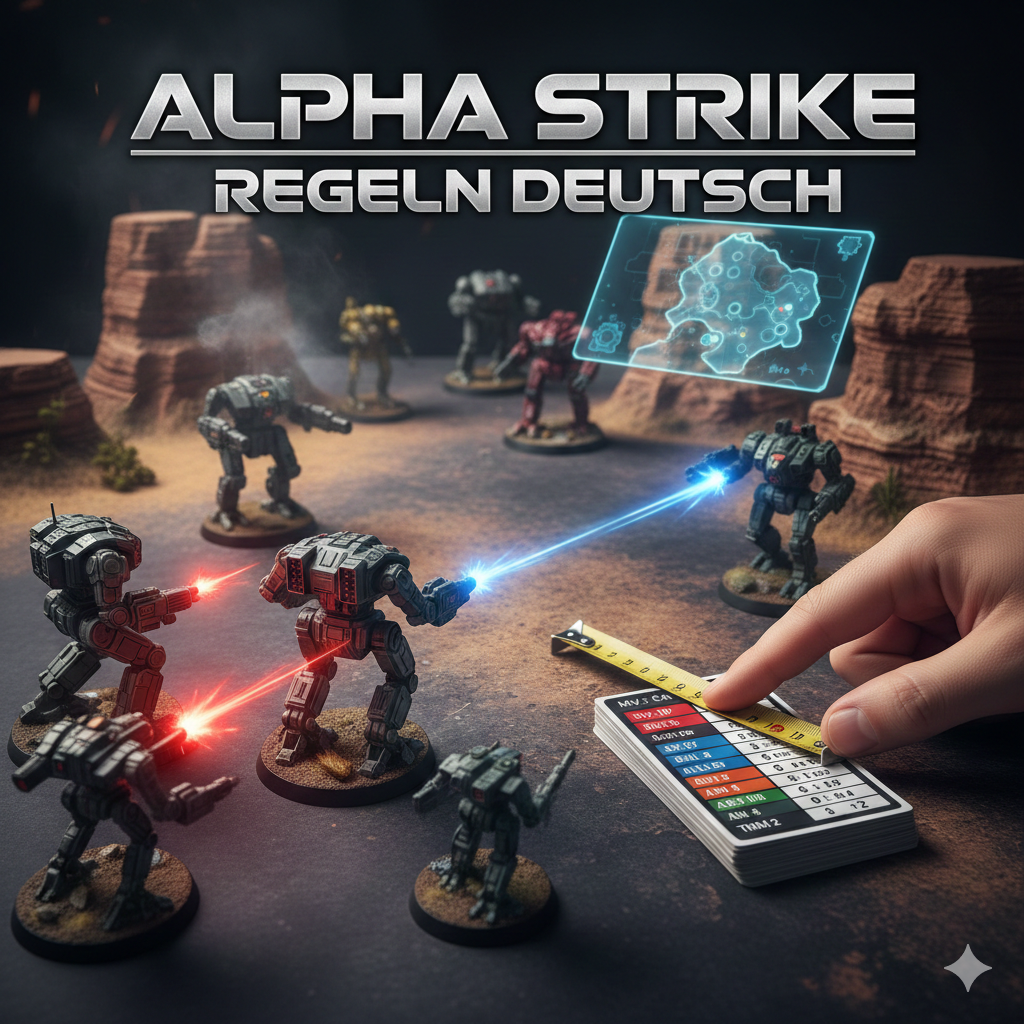
What makes the BattleTech Alpha Strike rules so special?
Anyone who grew up with the classic rules will be familiar with filling out armor boxes and calculating heat per laser beam. The Alpha Strike rules break this complexity down to the essentials.
- Fast game flow: A battle with 12 against 12 mechs often only lasts 90 minutes.
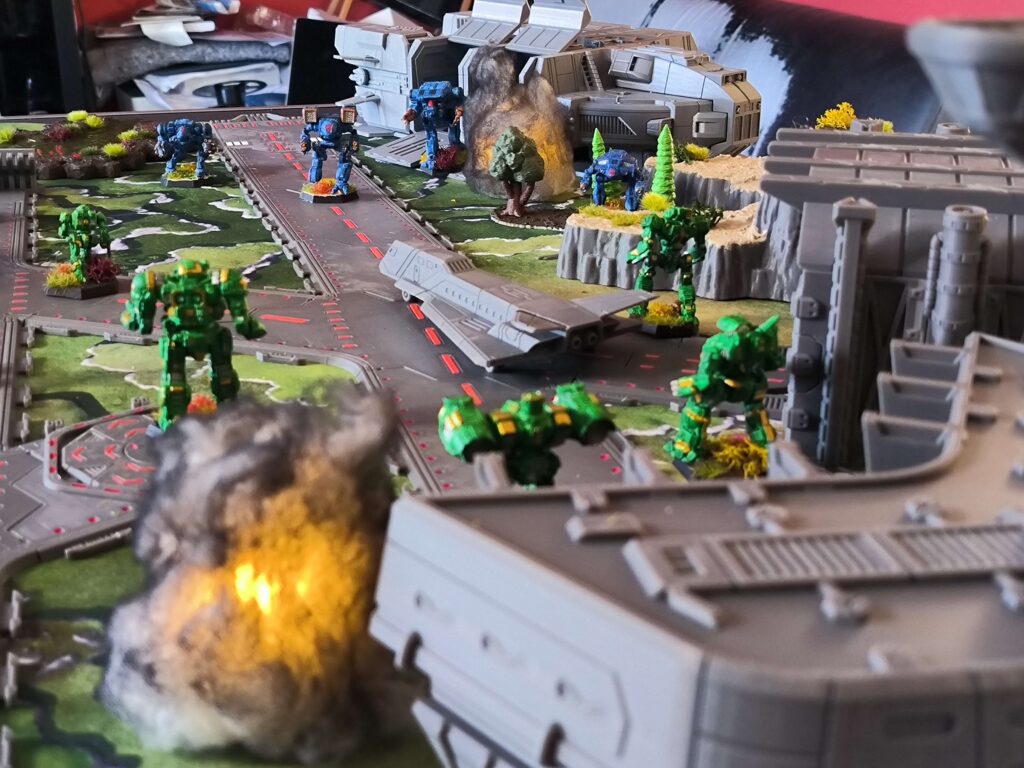
- 3D terrain instead of hexes: The game is usually played on a conventional tabletop board with a tape measure.
- Unit cards: All the values of a mech fit on a small card the size of a business card.
The core mechanics of the Alpha Strike rules (explained in German)
To get straight into the game, you only need to master a few basic concepts. Here is a summary of the most important points:
1. the unit card (Stat Card)
Each unit is defined by specific values that form the core of the Alpha Strike rules:
- MV (Movement): The range in inches.
- TMM (Target Movement Modifier): Your defensive bonus from movement.
- S/M/L (Short, Medium, Long): The fixed damage value at the respective distance.
- A/S (Armor/Structure): The health points of your mech.
- SPECIAL: Special abilities and properties of the unit
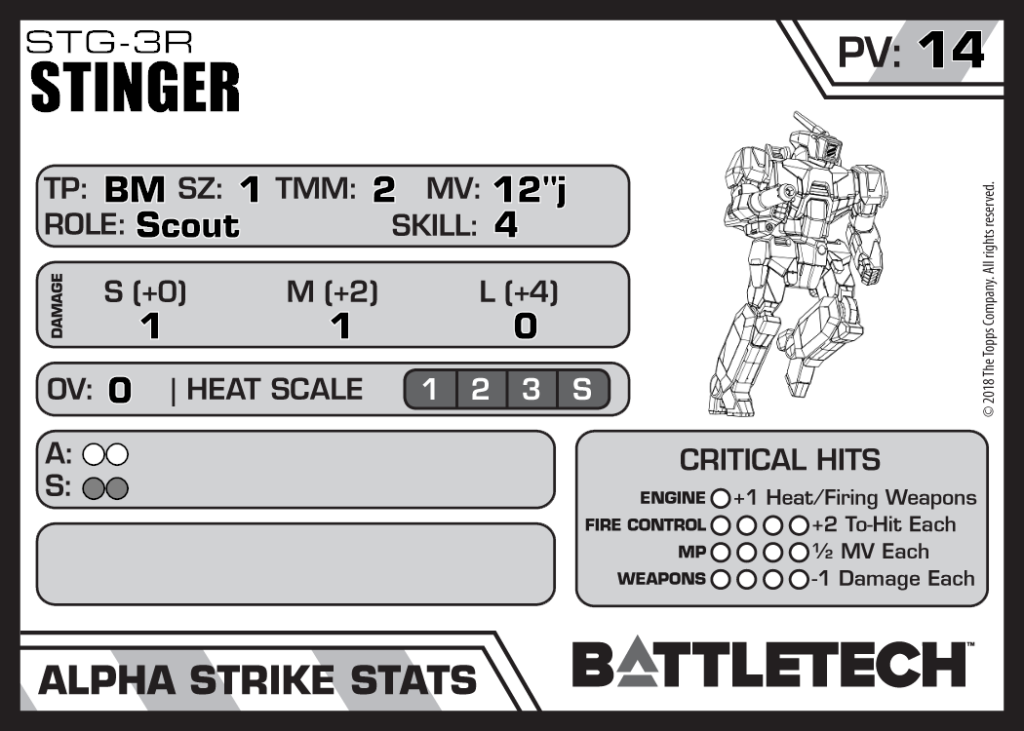
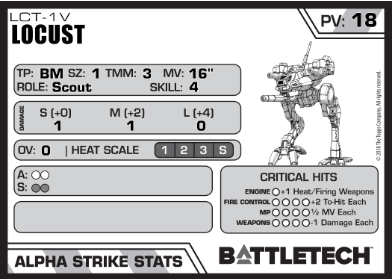
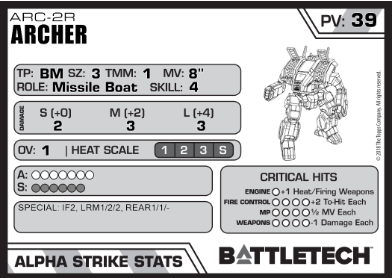
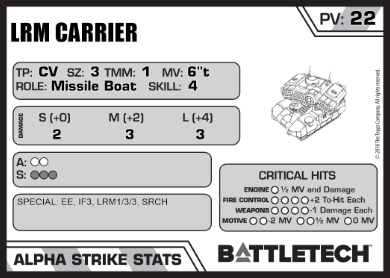
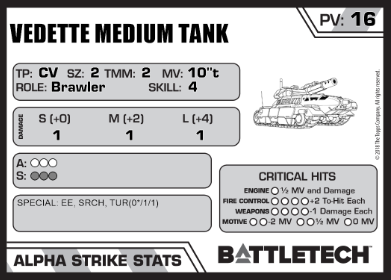
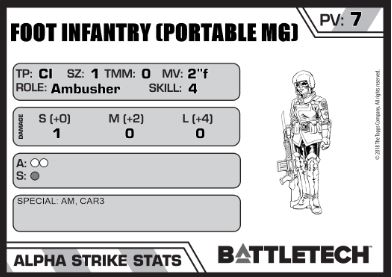
In BattleTech Alpha Strike, a game round is divided into four phases. Here is a brief overview of the most important rules.
2. the four phases of a game round
A game turn in BattleTech Alpha Strike consists of a fixed sequence of four phases in which all units on the playing field can act. The sequence is designed to simulate simultaneous action on the battlefield, with initiative playing a decisive role in the tactical order.
The phases are explained in detail here:
Initiative phase (Step 1: Initiative phase)
At the start of each turn, both players roll 2D6 (two six-sided dice). The player with the higher total wins the initiative for this turn; in the event of a tie, the roll is repeated.
- Tactical advantage: As movement and combat actually take place simultaneously during the course of the game, the initiative winner may carry out his actions after the loser. This simulates better situational awareness, as he can react to his opponent’s maneuvers.
Movement phase (Step 2: Movement Phase)
In this phase, players move their units according to their movement value (MV).
- Order: The player who has lost the initiative must move a unit first.
- Alternating activation: Players then take turns moving one unit at a time until all units have been moved.
- Unequal number of units: If one side has more units than the other, the player with the larger force must move proportionally more units with each activation (e.g. two instead of one) so that both sides finish their movements at the same time.
Combat phase (Step 3: Combat Phase)
Each unit may perform one attack in this phase (weapon attack or physical attack).
- Order: Here too, the player who has lost the initiative begins. In contrast to the movement phase, however, the actions are not carried out alternately here; the loser declares and resolves the attacks for all his units one after the other, followed by the initiative winner.
- Damage effect: The damage is determined immediately and marked on the unit card, but the effects (such as destruction or critical hits) only take effect in the final phase. This means that a unit that has been destroyed this turn still has the opportunity to fire back.
Final phase (Step 4: End phase)
This phase is handled simultaneously by both players. All remaining actions and status changes for the turn are calculated here:
- Destruction: Units that have taken enough damage are now permanently removed from the field.
- Heat: Units calculate their current heat (e.g. due to overheating), which affects the next move.
- Systems: Shutdown units can attempt to restart, and effects such as ECM shutdown or C3 by destruction are finalized.
As soon as all steps of the final phase have been completed, the game turn ends and the players return to step 1 until the scenario’s victory conditions have been met.
3. basics of movement / movement phase
- Movement value (MV): Each unit has an MV value on its card that indicates the maximum distance in inches it may move per turn.
- Order: The player who lost the initiative roll must move his first unit (or lance/star) first. The players then take turns moving.
- Proportional movement: If one side has more units, it must move proportionally more units with each alternation so that both sides finish at the same time.
- Direction and orientation: Units can move in any direction and face in any direction (facing) at the end of their movement.
Terrain and differences in altitude
- Terrain costs: Open terrain costs 1 inch per inch of movement. Difficult terrain such as rough (impassable) or woods (forest) costs an additional +1 inch per inch.
- Elevation changes: BattleMechs can climb inclines of up to 2 inches, which costs an additional 2 inches of MV per inch of elevation.
- Restrictions for vehicles/infantry: These units can only climb slopes of a maximum of 1 inch and pay 4 inches of MV per inch of height.
- Minimum movement: Each mobile unit may always move at least 2 inches as long as the terrain is not prohibited for that unit type.
Movement modes
- Standstill (standstill): If a unit moves less than 1 inch, it is considered stationary. This makes it easier to hit (TMM 0), but gives it a -1 bonus to its own attack roll.
- Jumping: Units with the code “j” can jump over terrain. They ignore terrain costs, but receive a +2 penalty to their own attacks.
- Sprinting (Sprinting): The unit increases its MV value by 1.5 times (rounded up), but may not make any attacks this turn.
Important maneuver rules
- Stacking: Units may move through friendly units, but may never end their movement in the same space as another unit. Passing through enemy units on the same level is prohibited.
- Transport: Units that are transported by other units (e.g. infantry in a tank) do not receive any movement of their own this turn.
- Immobile: Units with “MV 0” or those paralyzed by critical hits or heat are considered immobile and cannot use minimum movement.
- Movement Dice: It is recommended to place different colored dice next to units to mark the movement mode used and the resulting Target Movement Modifier (TMM).
4. the attack throw: simple and direct
In BattleTech Alpha Strike, SATOR is a helpful acronym that serves as a memory aid to correctly add up all the necessary modifiers for an attack roll.
The attack process essentially consists of dicing 2D6 against a modified target number. SATOR breaks down which values are included in this target number:
– S (Skill): The attacker’s skill rating forms the basic target number for the attack.
– A (Attacker Movement Modifier): This is the modifier for the attacker’s own movement. For example, a mech that has jumped receives a penalty (+2), while a stationary unit receives a bonus (-1).
– T (Target Movement Modifier): The target movement modifier (TMM) of the opponent. This is noted on the unit card and makes faster targets harder to hit.
– O (Other Modifiers): All other modifiers are summarized here. These include terrain effects (such as forests), partial cover, heat penalties from the attacker or modifiers from critical hits (such as fire control hits).
– R (Range Modifiers): The range modifiers based on the distance to the target (e.g. +0 for short, +2 for medium, +4 for long).
To summarize: You start with the skill rating(S) and add (or subtract) the values for A, T, O and R one after the other to get the final target number against which the dice must be rolled. Using SATOR in combination with Movement Dice can significantly increase the speed of the game.
A 2D6 roll against this target value decides whether you hit or miss. In the event of a hit, the full damage value of the card is deducted directly from the opponent’s armor.
5. special abilities (special ability codes)
Although the game is faster, the tactical depth is retained. Skills like IF (Indirect Fire)FLK (Flak) or REAR (Back Attack) ensure that each mech feels individual.
6. urban warfare – buildings in BattleTech Alpha Strike
In BattleTech Alpha Strike, buildings serve not just as decorative terrain, but as tactical elements that can provide cover, house units or act as targets themselves. Here are the detailed rules for using buildings on the battlefield.
Building types and integrity
Buildings are divided into four categories that define their structural stability and protective effect: Light, Medium, Heavy and Hardened. The durability of a building is expressed by the Construction Factor (CF); if this drops to 0, the building collapses.
| Building type | CF range (standard) | Weight capacity | Damage absorption (inf. / non-inf.) | Collapse damage (per 4″ height) |
|---|---|---|---|---|
| Light | 1-5 | 2 | 1 / 0 | 0* |
| Medium | 2-8 | 4 | 2 / 1 | 1 |
| Heavy | 6-18 | 6 | 3 / 2 | 2 |
| Hardened | 10-40 | 8 | 8 / 4 | 4 |
*Infantry in light buildings is nevertheless destroyed in the event of collapse.
Movement in and on buildings
Interaction with buildings depends heavily on the unit type:
- Infantry: It can enter buildings without additional movement costs and move between floors (cost: 1″ move per 1″ height). Infantry does not cause any damage to the building when moving through it.
- BattleMechs: Mechs can enter buildings, but cannot change their level within them. However, they can climb up the outside (maximum 2″ per inch of forward movement) or jump onto roofs.
- Damage from movement: Any unit (except infantry) that moves through a building automatically deals 1 point of CF damage to the building for every inch it moves inside.
- Weight capacity: Each building has a limit to the total size of the units it can carry. If the sum of the size values of all units on or in the building exceeds this capacity, the building collapses immediately. Non-armored infantry counts as size 0.
Combat rules for buildings
Buildings are considered immobile targets in combat, which grants attackers a -4 bonus to the target number.
- Attacking units inside: Units inside buildings benefit from damage absorption. When a unit inside a building is hit, subtract the building’s absorption value from the damage dealt; this subtracted damage is subtracted from the building’s CF instead.
- Special case infantry: Infantry inside cannot be attacked directly; the attacker must fire at the building itself. The infantry unit is then dealt the full damage of the attack minus the damage absorption of the building.
- Combat within the same building: If the attacker and target are in the same building, the damage absorption is halved (rounded down).
Collapse (Building Collapse)
A building collapses when its CF drops to 0 or its weight capacity is exceeded.
- Consequences for occupants: Infantry inside are automatically destroyed in the event of a collapse. Non-infantry units (such as mechs) take damage based on the height of the building (see table).
- Roof units: Units that were standing on the roof suffer an additional 1 point of extra damage.
- Aerospace units: If an aerospace aircraft or an extremely large unit (LG, VLG, SLG) attempts to land on a normal building, it will immediately collapse.
Extended rules
In advanced scenarios, buildings can function as armed positions. These “Advanced Buildings” have their own unit cards, can carry weapons or artillery and have their own skill values for automated defense systems. Armored Buildings can also have their own armor values, which must first be penetrated before the CF takes damage.
7. battlefield support
The Battlefield Support rules for BattleTech Alpha Strike allow artillery, minefields and air support to be integrated into the game without the need for full units (such as mechs or tanks) to be physically present on the field. These rules serve as a simplified method of representing external support elements.
Here is a detailed explanation of the rules:
The points system (BSP)
To request support, players use Battlefield Support Points (BSPs). Unless the scenario specifies otherwise, the players agree on a level of support points before the game:
- Extraction Raid Support: 5 BSP.
- Objective Raid Support: 12 BSP.
- Diversionary Raid Support: 20 BSP.
- Planetary Assault Support: 35 BSP.
Preparation and costs
Players secretly choose their support types before the game starts and write them down. Each type has a specific cost in BSP:
- Artillery: Thumper (2 BSP), Sniper (3 BSP), Long Tom (5 BSP).
- Offensive air support: Light Strike (2 BSP), Heavy Bombing (4 BSP), Strafing (5 BSP).
- Minefields: Light (0.5 BSP), Medium (2 BSP), Heavy (4 BSP).
Implementation during the game
- Time: Most support types are declared and used during the Combat Phase.
- Single use: Each selected support can generally only be used once, regardless of whether it causes damage or not (exception: minefields remain in place).
- Attack roll: Roll 2D6 against the base target number given in the Battlefield Support table.
- No modifiers: Unlike normal attacks, no modifiers (such as range, movement or terrain) are applied to these target numbers.
- Restricted targets: Completely submerged units (submerged) cannot be targets of Battlefield Support.
The different types of support
Artillery support
Artillery targets a Point of Impact (POI) on the map. A line of sight (LOS) is not required.
- Hit: If successful, a template (Area of Effect Template) is placed on the POI and all units in the radius take damage.
- Dodge (scatter): If the artillery misses, it deviates. The direction is determined with 1D6; the distance in inches corresponds to twice the difference (Margin of Failure) by which the throw failed.
Aerospace Support
- Strikes: A targeted attack on a single unit.
- Bombing: Targets a POI and causes area damage in a 2-inch radius. Missed throws also lead to a scatter effect.
- Strafing (low flight): The player establishes a 10 inch long and 2 inch wide path along the flight path. All units (friend and foe) in this area are attacked.
- Air Cover (air defense): These are defensive measures that can nullify enemy air attacks before they are rolled.
Minefields
Minefields work differently from the other types:
- Placement: They are already placed as 6-inch or 2-inch templates (often covered with coordinates) when the game is set up. Each minefield has a “density” (Density)
- Triggering: A unit on the ground triggers the mines as soon as it enters the area. The owner of the minefield rolls 2D6 against the target number (e.g. 8+ for Medium Density).
- Duration: A minefield remains active until the density of the minefield has dropped to 0. Each time the minefield is triggered, the density is reduced by one.
8th Line of Sight (LOS)
In BattleTech Alpha Strike, the Line of Sight (LOS) is one of the most basic requirements for carrying out an attack. It describes the direct, shortest line between two units.
The rules for the line of sight are explained in detail here:
Basic provision
The line of sight is determined from the perspective of the attacking unit. As a rule, this is done by moving to the eye level of the miniature and checking whether the target miniature is visible. If this is doubtful, aids such as a taut measuring tape, a string or a laser pointer can be used.
There are three categories of LOS:
- Clear LOS: No obstacles between the units.
- Obstructed LOS: Objects (such as smoke or forests) lie in between, but you can potentially see or shoot through them.
- Blocked LOS: The units cannot see each other at all through the terrain.
Blocking the line of sight through solid terrain
Lines of sight are blocked by solid terrain (such as hills or buildings) if:
- Less than a third of the target miniature is visible behind solid terrain.
- More than two thirds of the attacking miniature are prevented from seeing the target by solid terrain.
It is important that blocking the line of sight always works in both directions: If the attacker cannot see the target, the target cannot see the attacker. The maximum line of sight for ground units is 42 inches by default, provided there are no special environmental conditions.
Special features for non-rigid terrain (forests)
Woods do not automatically block the line of sight like hills. A LOS is only considered blocked if it runs through 6 inches or more of wooded terrain. If there is less woodland in between, the LOS is obstructed, which results in a penalty to the hit roll (+1 modifier).
Partial cover
This rule only applies to BattleMechs. A mech has partial cover if more than one-third but less than two-thirds of its miniature is hidden behind solid terrain. This does not block LOS, but gives the target a +1 modifier to the attacker’s target number. Forests do not provide partial cover.
Influence of water and immersion
- Partially Submerged: A mech in 1 inch of water receives partial coverage from the water.
- Fully Submerged: A unit is fully submerged when the water is deeper than its height (e.g. a mech in 2 inches of water).
- Fully submerged units have LOS to other submerged units in the same body of water.
- The LOS between a fully submerged unit and a unit on the surface (or out of the water) is blocked (except when using torpedoes).
LOS exceptions and other units
- Neighboring units: Units in base-to-base contact always have LOS to each other unless one is completely submerged or they are on different levels in buildings.
- Intermediate units: In most cases, other units have no influence on the LOS. Exceptions are landed DropShips, buildings and mobile structures, which act like fixed terrain. Large (LG) units also block the line of sight to smaller units.
- Indirect Fire: Units with the Indirect Fire (IF) special ability can attack targets without their own LOS if a friendly unit is acting as a “spotter” and has a valid LOS as a target
Blog posts in the category “Alpha Strike rules”
Lance types – simply explained
In BattleTech Alpha Strike, lance types (or formation types) are the smallest combat formations in an army. In the Inner Sphere , a lance consists of four units (usually BattleMechs…
BattleTech Alpha Strike vs. detailed rules from BattleTech Classic?
Does BattleTech Alpha Strike spoil the desire for the many detailed rules of BattleTech Classic? An experience report between two systems For many tabletop fans, BattleTech is synonymous with tactical…
Physical Attacks
Physical Attacks in BattleTech and their implementation in Alpha Strike The BattleTech series is known for its strategic battles between giant BattleMechs on the battlefield. While the focus is on…

Heat in BattleTech
Heat in the BattleTech universe: a central game mechanic and its implementation in Alpha Strike The BattleTech universe is characterized by its giant BattleMechs, which stomp across the battlefield, fire…

Movement phase in BattleTech Alpha Strike
Movement phase in BattleTech Alpha Strike: Standard movement and alternate movement with unequal numbers of units In BattleTech Alpha Strike, the movement phase is a central component of the game…

Forest in BattleTech Alpha Strike
The “Forest” terrain type in Battletech Alpha Strike: advantages and disadvantages in focus Forests are a key feature of many Battletech Alpha Strike battlegrounds and offer both tactical advantages and…
Indirect fire in Battletech Alpha Strike
Indirect fire in BattleTech: Alpha Strike – procedure, advantages and disadvantages BattleTech: Alpha Strike offers a more accessible alternative to classic BattleTech with its fast-paced, tactical gameplay. Nevertheless, it retains…
Rules for Battletech Alpha Strike
Rules for Battletech Alpha Strike BattleTech: Alpha Strike – A quick introduction to the world of mech battles BattleTech, the classic tabletop game, is famous for its tactical depth and…

Damage dice in Battletech Alpha Strike
Damage dice in Battletech Alpha Strike Battletech Alpha Strike has a much simplified set of rules for combat compared to the Classic variant. Possible hits and the resulting damage(damage dice)…
Comparison: Classic vs. Alpha Strike
| Feature | Classic BattleTech | Alpha Strike (DE) |
| Focus | Simulation of individual mechs | Tactical squad leadership |
| Measurement | Hex fields | Inch |
| Accounting | High expenditure (sheets of paper) | Minimal (cards) |
| Units (rough) | Lance against lance | Company against company |
Conclusion: Fast action in the 31st century
The Alpha Strike rules in German make BattleTech more accessible than ever before. You don’t lose the feeling of the mighty fighting machines, but gain the freedom to push entire armies across the battlefield.
Transparency notice on the use of AI (in accordance with the EU AI Act):
The content of this blog is personally conceived, researched and defined by me. I use generative artificial intelligence to help me formulate and structure the texts.
Why? This enables me to prepare complex issues more precisely and to focus fully on the quality of the content and research. The final editorial control and responsibility for all published content lies solely with me.
Together for better content!
This blog is a project of the heart that can only continue to grow with your help. Every comment, every recommendation – and especially your financial support – secures the future of this platform.
Do you want this content to remain freely accessible?
This is how you can support the mission:
- NEWSLETTER REGISTRATION: Become part of the fast-growing community and never miss an update again!
- BECOME A PATREON MEMBER: Join the inner circle and get access to exclusive material and early releases.
- OTHER SUPPORT: Whether it’s a donation, sharing a post or recommending the blog to others – every form of support counts!
Let’s make this blog an even better place together!

